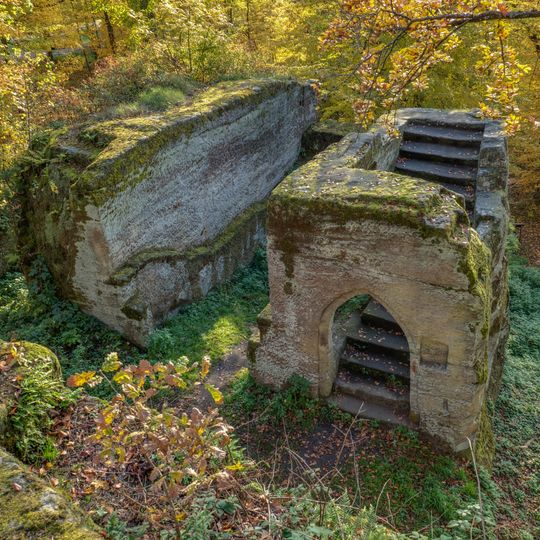
Höhenburg, Rock castle in Ebern, Germany.
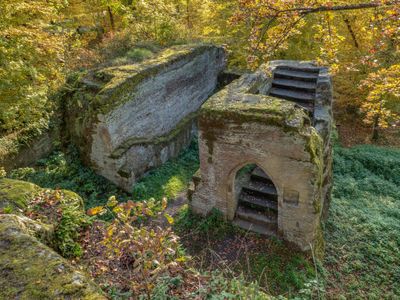
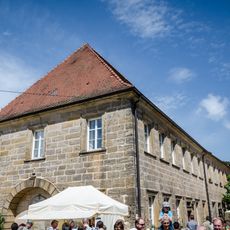
Burg Rotenhan is a ruined rock castle about two kilometres north of Eyrichshof, above the village on a sandstone outcrop at 380 metres. Five massive sandstone blocks, closely set, were joined by walls; the main gate was cut into the middle block of the southwest side. Grey and tan stone, patched with moss and lichen, survives as a long wall and a blocky tower with a rounded archway whose dark steps lead up.
The Rotenhan family is first documented in 1229 with Winther and Wolfram de Rotenhagen, so the castle existed by then. In 1323 the Bishop of Würzburg, Wolfram Wolfskeel von Grumbach, besieged it for about a year, citing counterfeiting and breach of feudal loyalty. After its capture it was destroyed and a 1324 treaty forbade rebuilding; the family later built Eyrichshof Castle below the hill.
The name Rotenhan probably comes from a cleared hedge or grove (gerodeter Haag), though some researchers link it to the Rodach stream. The red rooster on the family's crest was chosen to match the name, not the reverse. The family, first recorded in 1229 with Winther and Wolfram de Rotenhagen, still owns the ruin today.
The ruin lies about two kilometres north of Eyrichshof, above the village, and is reached on foot; the final stretch climbs to the site at 380 metres. The ground around the five sandstone blocks is uneven and partly overgrown, so sturdy shoes help. The castle is privately owned by the Rotenhan family, so keep to the paths and leave the masonry undisturbed.
The castle is one of the few true rock castles in Germany: five massive, closely spaced sandstone blocks were linked by walls, and the main gate was cut into the middle block of the southwest side. Some components look unfinished, perhaps because the site was besieged and destroyed during a building phase.
The community of curious travelers
AroundUs brings together thousands of curated places, local tips, and hidden gems, enriched daily by 94,637 contributors worldwide.