German Hygiene Museum, Medical museum in Dresden, Germany.
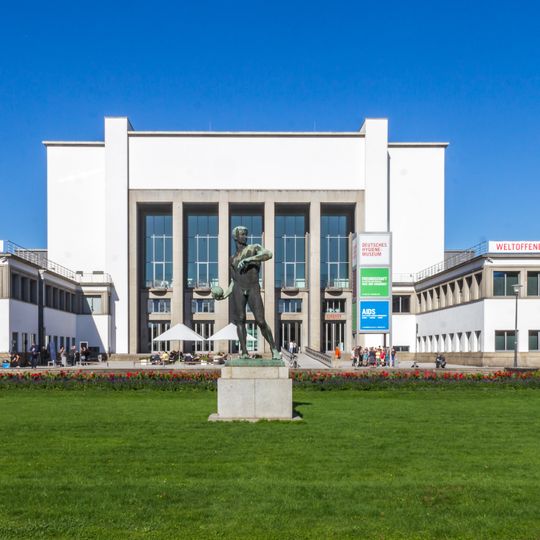
The German Hygiene Museum is a broad white building with a flat roof, designed by Wilhelm Kreis and opened in 1930 west of the Großer Garten. Its central block is recessed behind five tall, narrow window bays set in a dark grid, flanked by lower wings with long horizontal window bands. A bronze statue of a standing figure holding a sphere stands on a stone base before the lawn.
Karl August Lingner, a Dresden manufacturer of the Odol mouthwash, founded the museum in 1912 as a public venue for healthcare education after the first International Hygiene Exhibition. The present building by Wilhelm Kreis, between Neoclassicism and Bauhaus, opened in 1930 west of the Großer Garten. Bombing destroyed much of it in February 1945; it was rebuilt in the GDR era and renovated by Peter Kulka from 2001 to 2005.
The museum's name comes from the hygiene movement of 1912, when founder Karl August Lingner wanted to educate ordinary citizens about the body. Today the permanent exhibition "Abenteuer Mensch" and the children's museum "Unsere fünf Sinne" carry that idea on, alongside temporary shows such as "War and Medicine" and "What Is Beautiful?".
The museum is located in central Dresden and is easy to reach on foot or by public transport. Visitors should set aside a few hours to explore the exhibitions at a comfortable pace.
A famous display shows the internal organs and structures of the human body in transparent and realistic form. This exhibition remains the most memorable experience for many visitors to the museum.
The community of curious travelers
AroundUs brings together thousands of curated places, local tips, and hidden gems, enriched daily by 94,049 contributors worldwide.