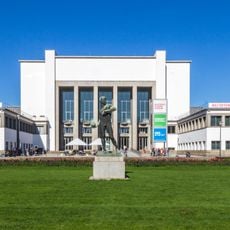
Bürgerwiese, Public park and cultural heritage monument in Dresden, Germany.
Bürgerwiese is Dresden's oldest green space, a landscaped garden of about ten hectares running 850 metres long and 80 to 100 metres wide between Georgplatz and Lennéplatz. It lies in the Seegraben, the old Elbe riverbed crossed by the Kaitzbach, along the border of Seevorstadt and Pirnaische Vorstadt, and joins the Blüherpark to the north and the Großer Garten to the east.
Originally used as shared grazing land, the area was transformed into Dresden's first urban park in 1869 based on designs by landscape architect Peter Joseph Lenné. This transformation represented a major shift in how the city approached public green spaces.
The Mozart Fountain, made by Berlin sculptor Hermann Hosaeus in 1907, shows three gilded bronze figures representing Grace, Cheerfulness and Earnestness dancing around a Mozart memorial stone. It was partly destroyed in 1945 and removed; Gerhard Wolf completed a reconstruction in 1991. Nearby stands the three-metre Nymphenbrunnen of 1908, with a granite basin eight metres wide by Wilhelm Kreis and a white marble nymph by Bruno Fischer.
The Bürgerwiese runs 850 metres from Georgplatz to Lennéplatz, between 80 and 100 metres wide, along the Bürgerwiese and Parkstraße streets. It borders the Blüherpark to the north and continues east to the Großen Garten, so the three green spaces can be walked as one route. The Kaitzbach flows through the former Seegraben channel.
Heinrich Epler's bronze group 'Zwei Mütter', made between 1899 and 1902, shows a human mother and a tigress pulling their children from flood water. It stands among the many large sculptures in the Bürgerwiese, which also include the Mozart Fountain, the Nymphenbrunnen and the Otto-Ludwig-Herme.
The community of curious travelers
AroundUs brings together thousands of curated places, local tips, and hidden gems, enriched daily by 93,938 contributors worldwide.