Osterstein Castle, Medieval castle in Zwickau, Germany
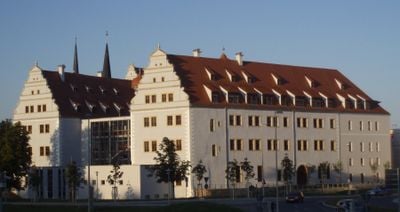
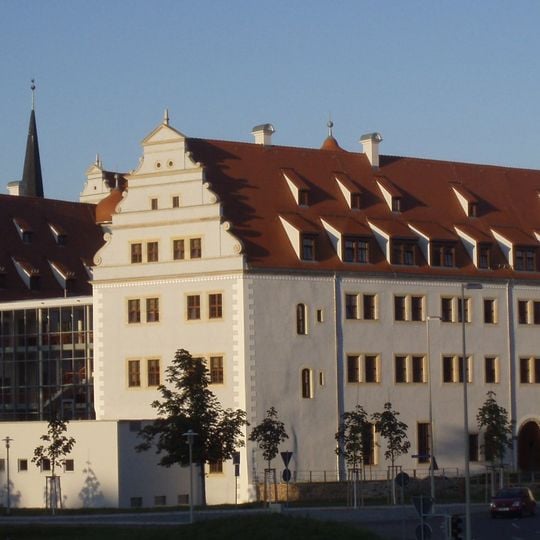
Osterstein Castle is a former electoral residence and prison in Zwickau, Saxony, near the Zwickauer Mulde. Its white plastered walls and steep red tiled roof with a curved gable and small spire date from the 1587–1590 Renaissance rebuilding. A dark slate spire rises from a lower wing, and rows of rectangular windows with dark frames cross the facade.
The site was first documented in 1292 as a medieval fortification and evolved over centuries. A major transformation occurred between 1587 and 1590 under Christian I, Elector of Saxony, who reshaped it into its present Renaissance form.
The castle's name changed over time: until the late 16th century it was known as Schloss Weißenstein, and the name Osterstein came into use with the Renaissance rebuilding of 1587–1590. In the preserved cross-vaulted cellar, the Mauritius Schloss Schenke opened on 8 October 2016. The Große Hofstube, a two-aisle vaulted hall of about 175 m² with two Tuscan columns of Cainsdorfer sandstone, is among the best-preserved Renaissance court rooms in Saxony; written sources record meals at 20 tables at once.
The building currently operates as a nursing home and is not open for general visits. You can view the exterior and surrounding areas from outside, while interior sections are reserved for exhibitions and occasional cultural events.
The prison period began in 1770-1775, when the castle was converted into a penitentiary, and ended on 31 December 1962 after 187 years. In March 1933 it briefly held a Schutzhaftlager, then served as a Zuchthaus until 1945. The Great Hall, a 175 m² vaulted room with two Tuscan columns of Cainsdorfer sandstone, is among Saxony's best-preserved Renaissance court halls.
The community of curious travelers
AroundUs brings together thousands of curated places, local tips, and hidden gems, enriched daily by 93,096 contributors worldwide.