Merkurbrunnen, Renaissance water well in Maximilianstrasse, Augsburg, Germany
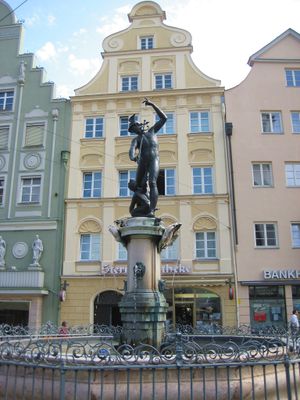
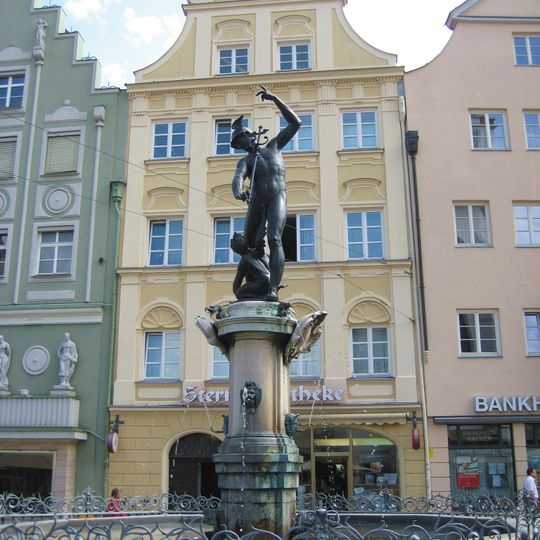
The Mercury Fountain is a Renaissance water well on Maximilianstrasse featuring a bronze Mercury statue holding a staff, wearing a winged helmet, with decorative animal heads on the pillar that spout water. The fountain combines mythological imagery with functional water delivery in a single ornate structure.
Adriaen de Vries modelled the fountain in 1596–1599 and Augsburg city caster Wolfgang Neidhardt cast it. Inscriptions on the pillar name the city stewards who commissioned it, Johann Welser and Oktavian Sekundus Fugger, and those who accepted it, Oktavian Sekundus Fugger and Quirin Rehlinger. Repairs are recorded for 1628, 1661, 1713 and 1752, when Rococo cartouches were added.
Mercury was already venerated in Augsburg in antiquity; the Celts saw him as the inventor of the arts and a guide on journeys. As god of trade he points to the city's role as a trading metropolis. The winged boy Amor at his side loosens or ties the god's winged shoe.
The original bronze sculptures are kept at the Maximilian Museum, while replicas remain at the fountain for public viewing throughout the day. The location on Maximilianstrasse makes it easy to visit while exploring the city's main shopping and cultural street.
The four-sided pillar carries two rocaille cartouches added in 1752, when the fountain was restored and enlarged. Its inscriptions name the two city stewards (Stadtpfleger) in office at each stage, from Johann Welser and Oktavian Sekundus Fugger, who commissioned the work in 1596, to the officials of 1752.
The community of curious travelers
AroundUs brings together thousands of curated places, local tips, and hidden gems, enriched daily by 92,947 contributors worldwide.