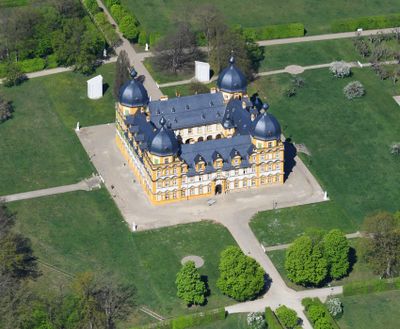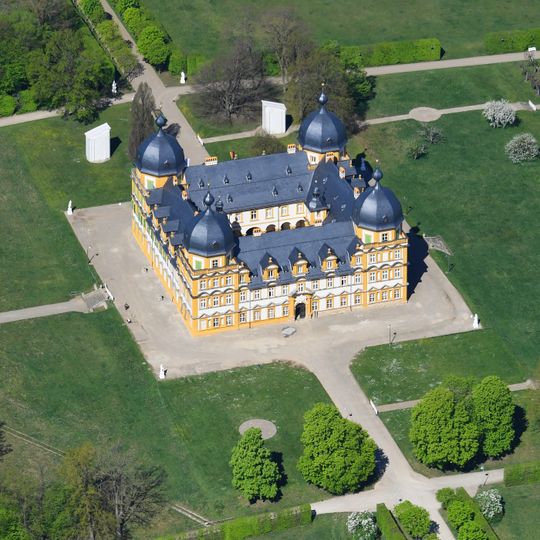
Schloss Seehof, Palace in Memmelsdorf, Germany.
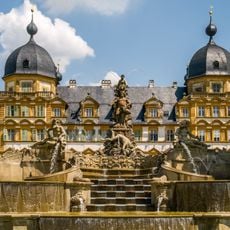
Schloss Seehof is a four-winged baroque palace built for the Bamberg prince-bishops, standing on a square plan with corner pavilions topped by squat octagonal towers and slate hoods with pierced ball ornaments. Its yellow-orange facades are divided by white pilasters and rows of large windows, with triangular gables below and arches above. The inner court is ringed on the ground floor by an arcade and has two small clock towers.
Construction began in 1684 under Prince-Bishop Marquard Sebastian von Schenk von Stauffenberg following designs by Antonio Petrini and was completed around 1695. The palace served as a summer residence for the prince-bishops of Bamberg and embodies the architectural style of the baroque era.
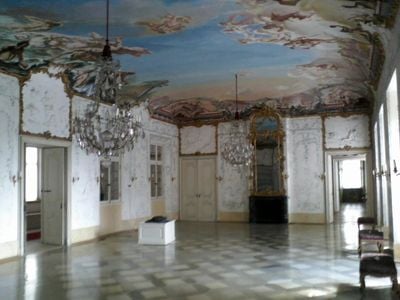
The ceiling of the Rococo Hall (Rokokosaal) in the centre of the upper floor carries a fresco by Giuseppe Appiani painted in 1752, showing the goddess of dawn. The hall's walls are covered with gypsum "marble" and reliefs painted by F. A. Decourt. The palace chapel holds a Rococo stucco altar by Antonio Bossi after a drawing by J. J. M. Küchel, with an altar painting of the Three Magi by Johann Rottenhammer (c. 1600).
The grounds are best explored in dry weather, as pathways through the gardens can become slippery after rain. Comfortable walking shoes are recommended, and visitors should allow time to stroll through the outdoor areas at a leisurely pace.
The cascade was built from 1764 and first operated in 1771, designed by Johann Michael Fischer with sculpture by Ferdinand Tietz. Water reached it through a roughly six-kilometre pipe and a 640-metre walkable tunnel driven through the Stammberg. The fountains were drained in 1803–6 after the pipe was cut; the cascade was restored after 1995.
The community of curious travelers
AroundUs brings together thousands of curated places, local tips, and hidden gems, enriched daily by 94,123 contributors worldwide.