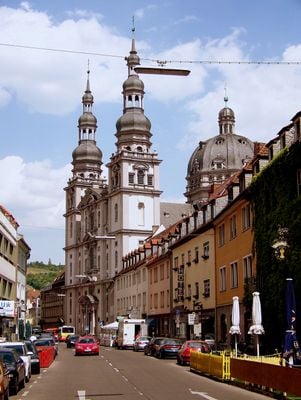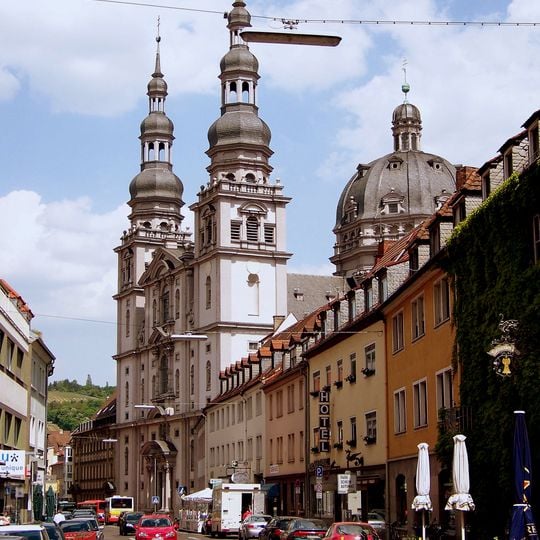
Stift Haug, Würzburg, Baroque church in Würzburg, Germany
Stift Haug is a Baroque church in Würzburg featuring a prominent dome rising about 60 meters above the transept crossing. Its interior underwent comprehensive renovation until 2005 and displays classical Baroque architecture with elaborate details.
The collegiate foundation dates to around 1000, when Bishop Heinrich I consecrated a monastery north of the city wall; the name Haug derives from houc, meaning hill. In 1657 the old site was demolished to make room for the Baroque city fortifications, and Antonio Petrini built the present church between 1670 and 1691. The college was dissolved in the secularization of 1803, after which the church became a parish church.
The church serves as a venue for musical performances featuring the large Johannes Klais organ from 1971. Visitors can experience regular concerts that keep the musical tradition of this place alive.
The church is easy to reach and offers good views of its Baroque spaces. Visitors should note that regular concerts and religious ceremonies take place, which may affect access.
The monumental crucifixion painting behind the high altar, 9 by 5.5 metres, was made by Jacopo Tintoretto in 1585 for Munich's Augustinerkirche and hung here only in 1964, replacing the altar destroyed in 1945. Its modern base carries the Latin inscription "ECCE LIGNUM CRUCIS IN QUO SALUS MUNDI PEPENDIT VENITE ADOREMUS".
The community of curious travelers
AroundUs brings together thousands of curated places, local tips, and hidden gems, enriched daily by 94,019 contributors worldwide.