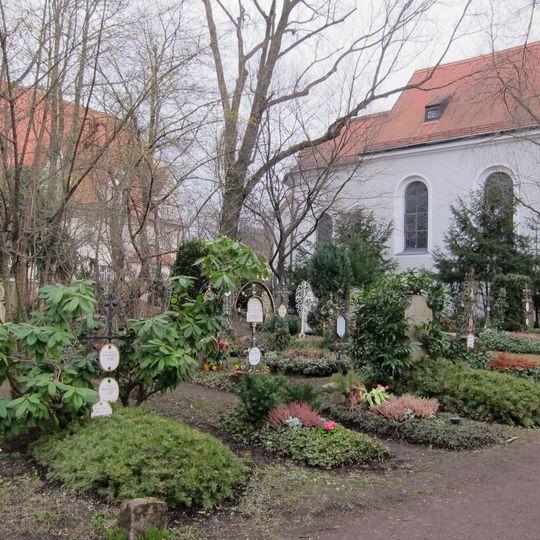
Bogenhausener Friedhof, Cemetery in Bogenhausen district, Germany.
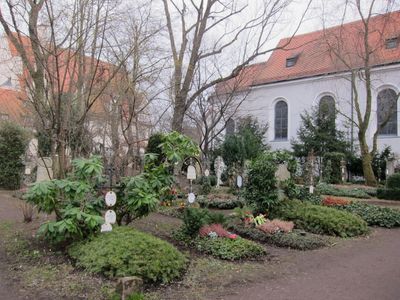
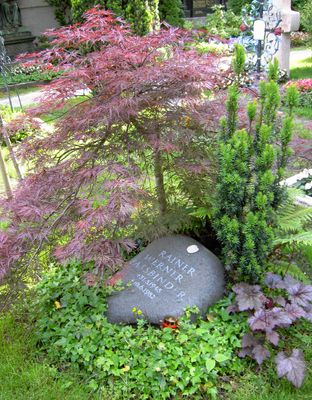
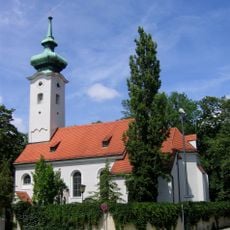
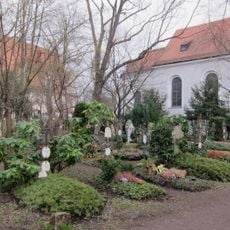
Bogenhausener Friedhof is a small burial ground beside the late Baroque St. George's Church on the right bank of the Isar. It is enclosed by an ivy-covered wall and divided into three grave fields. The plots are bordered by low green hedges, with simple iron crosses and small stones rather than mausoleums. A flat dark grey slab marks the grave of Rainer Werner Fassbinder, inscribed with his name and dates 26.5.1945 and 4.06.1982.
The cemetery is documented as early as the 9th century, when it served the old-established Bogenhausen families. Bogenhausen was incorporated into Munich in 1892, but the former village cemetery passed to the city only in 1902. It was completely redesigned in 1952, and in 1959 the municipal section, grave field 3 and the wall graves were relaid in an open form.
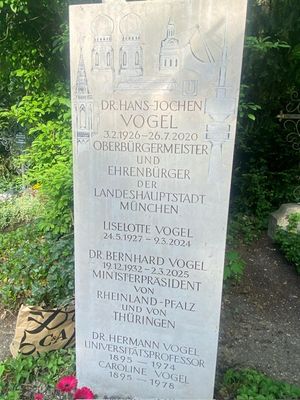
The cemetery holds the graves of renowned artists and writers who shaped Munich's cultural life. The burial sites reflect the city's artistic heritage through those honored here for their contributions to film, literature, and theater.
The ground rises gently from the southern plots toward the church, and the paths between the hedge-bordered graves are uneven in places. The cemetery is divided into three grave fields, with the old southern section and wall graves belonging to the parish foundation and most of the northern part to the city. Grave plots are held for 15 years.
The cemetery has only 208 grave plots, and a plot can be acquired only after a current death, for someone who lived at least 30 years in Bogenhausen districts 13.35 and 13.71–13.75 south of the Isarring, or for a personality the city deems deserving. The grave of director Rainer Werner Fassbinder (1945–1982) lies under a flat dark grey slab with a small stone and a red candle.
The community of curious travelers
AroundUs brings together thousands of curated places, local tips, and hidden gems, enriched daily by 94,546 contributors worldwide.