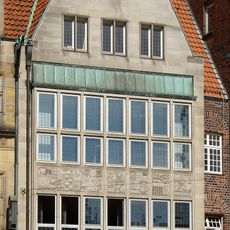
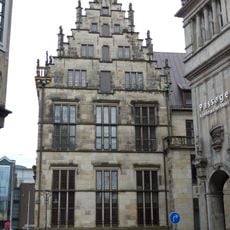
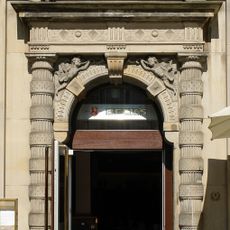
Bremer Marktplatz, Medieval square in Mitte, Germany
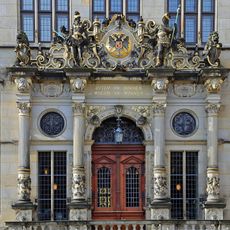
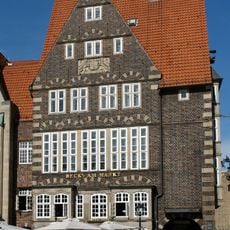
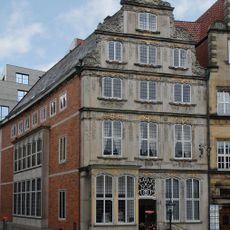
Bremer Marktplatz is a trapezoidal square of about 3,484 m², its longest side 74 m, paved with sandstone since 1863. Inside a circle of columns, darker stones form a ten-spoke wheel 4.8 m across with a reddish Hanseatic cross at its centre. The square is bordered by the Town Hall, the Schütting (1537–1538) and the parliament building.
The square began as a trading center during the early medieval period and remained the economic heart of the city for centuries. Its current appearance, with the Town Hall and surrounding structures, developed over time and made it a symbol of the city's autonomy and power.
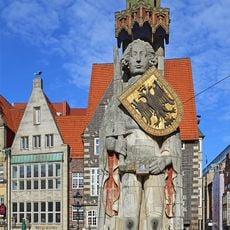
Locals call the square the city's "good room". The Christmas market and the Kleine Freimarkt still occupy it, and tram lines 2 and 3 run between the Town Hall and the Roland. The 4.8 m wheel of dark stone with a reddish Hanseatic cross in its centre, laid in 1863, marks the square's centre.
The whole square and several adjoining streets are a pedestrian zone, but tram lines 2 and 3 run along the northwest side between the Town Hall and the Roland statue. The square is a slightly indented trapezoid, with sides of 60, 54, 51 and 74 metres. Five streets open onto it and two more squares adjoin it.
The square's paving, renewed between February and June 2002, keeps its historical layout: inside the circle of columns, darker stones form a ten-spoke wheel 4.8 m across, with a reddish Hanseatic cross at its centre commemorating the Hanseatic Legion of the 1813–1815 Wars of Liberation.
The community of curious travelers
AroundUs brings together thousands of curated places, local tips, and hidden gems, enriched daily by 93,015 contributors worldwide.