Market Church, Gothic church in Mitte, Hanover, Germany
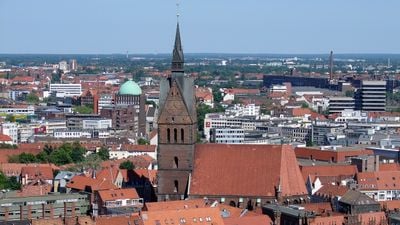
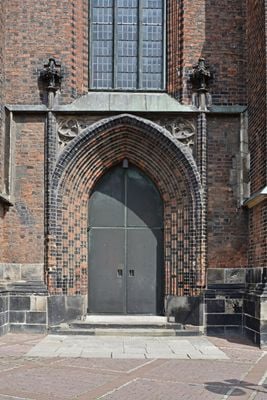
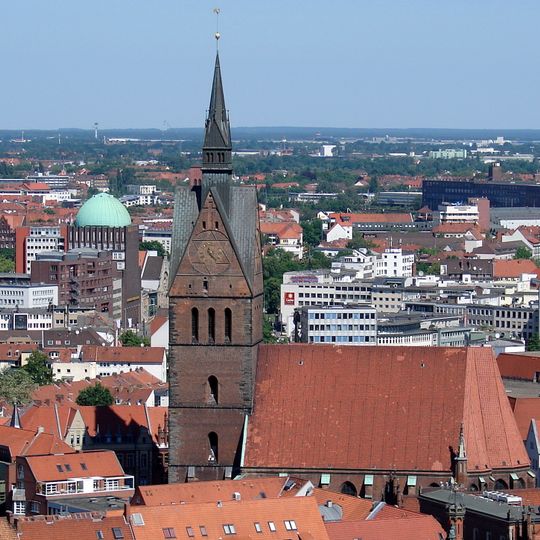
The Market Church is a three-nave hall church of red brick, 61.5 m long and 26.6 m wide, with a 97 m west tower topped by a slender spire and a golden orb and cross. Its walls are brownish-red brick with tall pointed windows, and the west portal is a recessed pointed arch of alternating red and black brick layers with two dark metal doors.
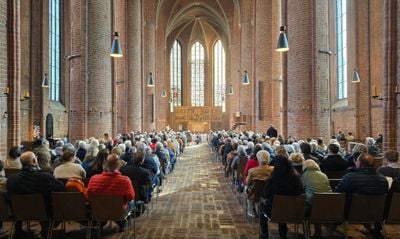
A Romanesque predecessor church stood on the site from around 1125 and was recorded as St. Georgii in 1238; its foundations were found in 1952 excavations. The present church was dedicated around 1360, and tower construction, begun in 1347, was halted in 1368 because of plague and lack of money, leaving the spire lower than planned. Air raids in July and October 1943 destroyed the interior; Dieter Oesterlen rebuilt it 1946–1952.
The name refers to Saint James the Elder, patron of pilgrims and merchants, and Saint George, one of the Fourteen Holy Helpers, both named in a 1342 Latin document. The church is the preaching church of the state bishop of the Evangelical-Lutheran Church of Hanover and of the city superintendent, and it also serves the city council and the Lower Saxony state parliament.
The tower stands on the west side, facing the market square that grew up beside the church; the main body with its tall pointed windows extends east behind it. The west portal and the tower corners are sandstone, the rest red brick. The church is the preaching church of the regional bishop and the city superintendent, and the church of the city council and the Lower Saxony state parliament.
The tower's spire was replanned after construction halted in 1368 during plague and money shortages: instead of the intended steep point, it received a small lantern shaped as a miniature copy of the tower itself. The roof timbers felled 1385–1388 were confirmed by dendrochronology.
The community of curious travelers
AroundUs brings together thousands of curated places, local tips, and hidden gems, enriched daily by 92,642 contributors worldwide.