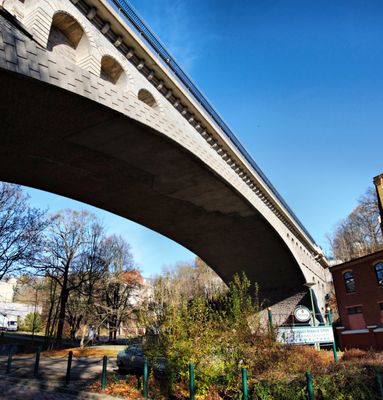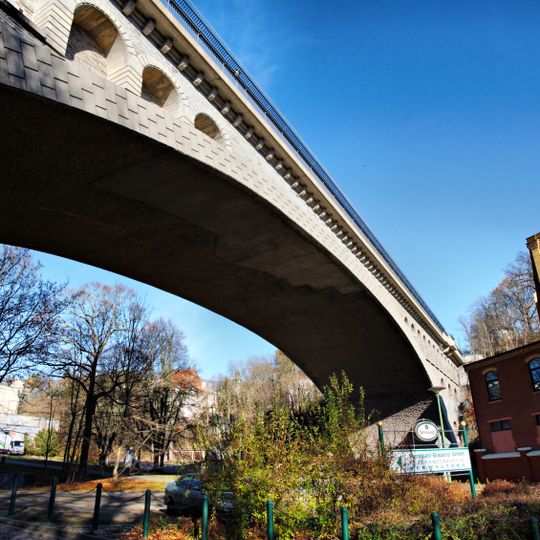
Syratalviadukt, Stone arch road bridge in Plauen, Germany.
The Syratalviadukt, also called Friedensbrücke, is a rubble-stone arch bridge over the Syrabach valley with a single basket-handle main arch of 90 m clear span and 18 m rise. The arch is 4 m thick at the springing and 1.5 m at the crown, built of phyllite from Theuma and Tirpersdorf. The bridge is 133 m long, 18 m wide and carries the B 92 with four lanes and footpaths on both sides.
Planning began in the 1870s; in 1901 the city received 23 designs, and the firm B. Liebold und Co. won with a single basket-handle arch of 90 m span. Work started on 26 March 1903, and the arch was closed on 26 November 1903. The bridge opened in 1905, and its record span stood until the Hongdu Bridge in Guangxi passed 100 m in 1965.
Locals call it Syratalviadukt after the Syrabach valley it crosses, and the name Friedensbrücke (Peace Bridge) came later. The bridge is a protected heritage monument of Saxony. Its granite parapet is solid over the abutments and open in the middle, and the roadway once carried two one-metre tram tracks that were not reinstalled after wartime damage.
The bridge carries the four-lane Bundesstraße 92 with footpaths on both sides, so it can be crossed by car or on foot. The 13.2-metre side arch was built as a passage for a road through the Syratal that was never constructed. The valley below and the arch can be viewed from the paths in the Syratal.
The bridge carries multiple historical names reflecting its changing history over time. These different designations reveal how important the structure became to the city's identity.
The community of curious travelers
AroundUs brings together thousands of curated places, local tips, and hidden gems, enriched daily by 93,996 contributors worldwide.