Marstall, Cultural heritage monument in Heidelberg, Germany.
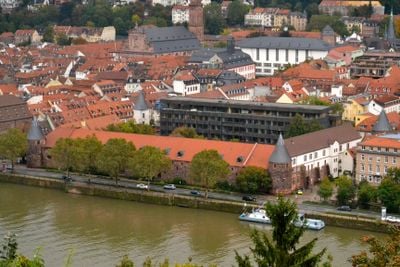
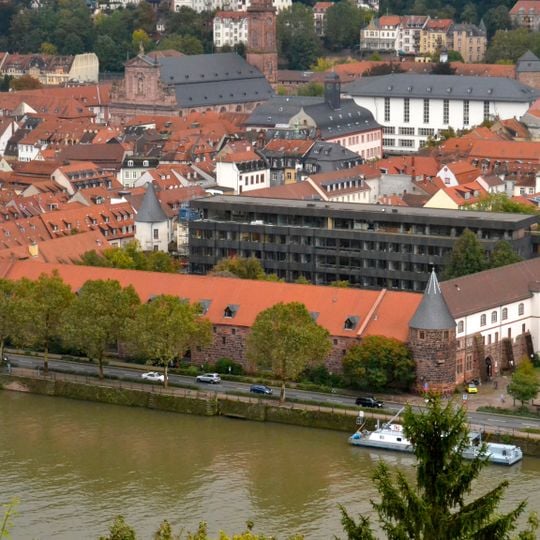
The Marstall is a 135-metre-long arsenal and former gun foundry of reddish-brown Neckar valley sandstone running along the Neckar in Heidelberg's old town. Its long tiled roof carries small dormer windows, and a round tower with a steep dark grey conical roof closes the eastern end. Watchtowers with loopholes for hand firearms stand at both ends of the river front.
The building was probably erected around 1510 under Elector Ludwig V as an arsenal and gun foundry, directly on the Neckar, after Heidelberg was besieged in the Landshut War of Succession in 1504. The architect is thought to have been Lorenz Lechler, a Palatine master builder and gunner. The name Marstall comes from a Renaissance stable built in 1590 under Count Palatine Johann Casimir on the south side of the courtyard, destroyed in 1693 during the War of the Palatine Succession.
The building houses student services and dining facilities for Heidelberg University today. Walking through, you notice how this historic structure is woven into daily university life and constantly used by students.
The complex runs along the north bank of the Neckar, its 135-metre front facing the river; the historic entrance side is the west, at Krahnenplatz. The central arched gate on the river front is now glazed. The building is in use as the Zeughaus-Mensa and the Studierendenwerk offices, so visitors should expect the courtyard and interior to be busy at mealtimes.
The name Marstall is misleading: the long riverside building was originally the Zeughaus, an armoury and gun foundry. The actual stables stood in a separate Renaissance building on the south side of the courtyard, built in 1590 under Johann Kasimir and destroyed in 1693; its ground floor held stalls for over a hundred horses.
The community of curious travelers
AroundUs brings together thousands of curated places, local tips, and hidden gems, enriched daily by 93,359 contributors worldwide.