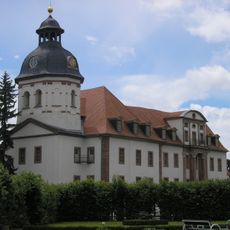
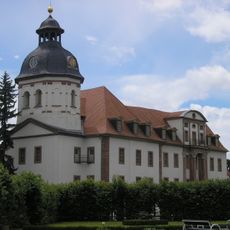
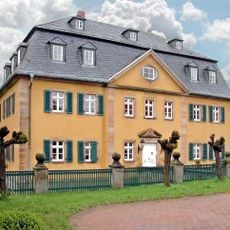
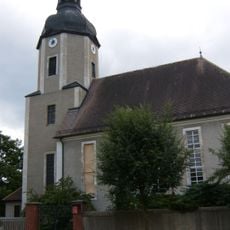
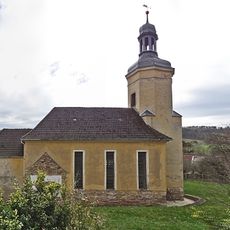
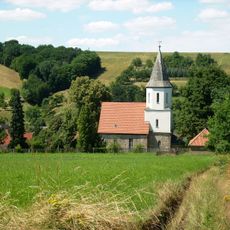
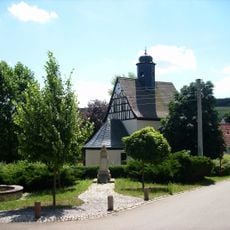
Crossen Palace, Baroque palace in Crossen an der Elster, Germany.
Crossen Palace is a Baroque manor house set on a hillside in the White Elster valley, designed with Italian-style decorative elements throughout its interior. The building contains a grand ballroom and large reception spaces that showcase the architectural details typical of the period.
A castle stood here from the 13th century; the Saxon elector August had Wolf Ernst von Wolframsdorf rebuild it as a Renaissance palace in 1585. Leipzig merchant David Fleischer, later von Fletscher, demolished it and erected the Baroque palace between 1701 and 1712, keeping only the Romanesque bergfried. In 1724 Count Jacob Heinrich von Flemming acquired it; his family held it for 200 years. Irish investors bought it in 2007.
The two-storey festival hall in the south wing was decorated in 1712 by Giovanni Francesco Marchini from Como, who had previously worked at Schloss Bruchsal and St. Martin in Bamberg. His trompe-l'œil paintings simulate architectural structure, and the hall is considered the only surviving illusionistic total artwork of its kind in Thuringia. Its motifs are scenes from classical mythology and images of gods.
The palace is located in the region between Gera and Zeitz along the White Elster and remains closed to public entry. Visitors can observe the exterior and appreciate the Baroque design and its position within the valley landscape.
The Baroque hall owes its ceiling to Giovanni Francesco Marchini of Como, hired in 1712 by David Fleischer; Marchini had worked at Schloss Bruchsal and St. Martin in Bamberg. It is the only surviving illusionistic total artwork in Thuringia. The palace was bought by the town of Bad Köstritz in March 2017 after a decade of vacancy.
The community of curious travelers
AroundUs brings together thousands of curated places, local tips, and hidden gems, enriched daily by 93,756 contributors worldwide.