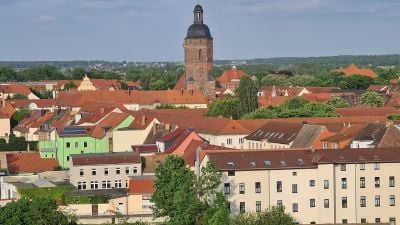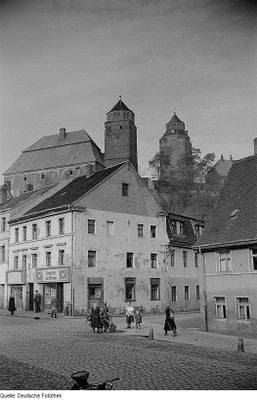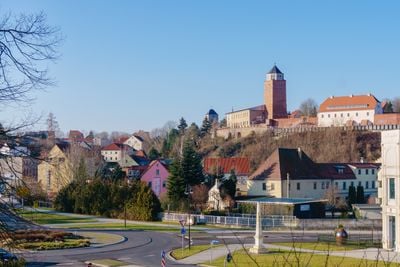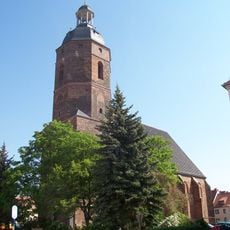
Burg Eilenburg, Medieval castle in Eilenburg, Germany.
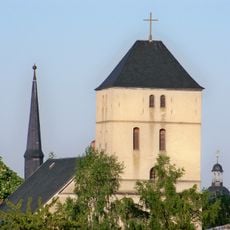
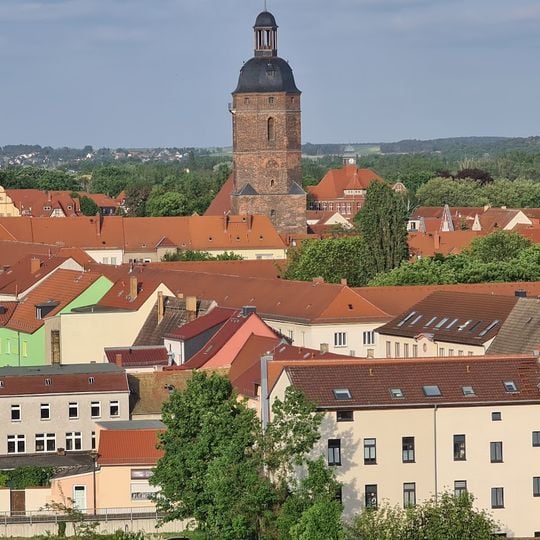
Burg Eilenburg is a medieval fortress on a hilltop above the Mulde River, made up of two brick residential towers, a ring wall, and multiple moats. A baroque administrative building sits on the grounds, added later to complement the original fortification.
A Slavic hillfort of the 9th century, it became the centre of the Burgward Ilburg by the mid-10th century and appears as 'civitas Ilburg' in a document of Otto I dated 29 July 961. Around 1000 it passed to the Wettin counts, and in the decades around 1200 two brick residential towers and a ring wall were built. In 1644 Swedish troops captured it during the Thirty Years' War, after which the damaged castle was quarried; the Amtshaus and prison date from the 17th and 18th centuries.
The name Eilenburg derives from the Slavic settlement of Ilburg recorded in 961; the castle also gave its name to the noble family von Eulenburg, one of the Wettin dynasty's most important ministerial families. The Sorbenturm, a residential tower, is named after the Sorbian castle men who likely lived there.
The castle sits on the Schloßberg, a clay oval hill whose top rises 132.5 to 135 m above sea level, roughly 30 m above the town centre. Earth ramparts up to ten metres high remain on the hill and can be seen along the approach. The baroque Amtshaus has carried a provisional roof since a 1993 arson fire destroyed its mansard roof, and damage has since appeared inside.
The castle is sometimes called the "cradle of Saxony": in 1089 the March of Meissen was granted to Frederick of Eilenburg, the castle's owner, which established Wettin rule over the territory that became Saxony. The two surviving towers differ in material: the so-called Sorbian Tower is of light sandstone, the southern tower of red brick.
The community of curious travelers
AroundUs brings together thousands of curated places, local tips, and hidden gems, enriched daily by 92,624 contributors worldwide.