Burg Endenich, Medieval castle in Bonn, Germany
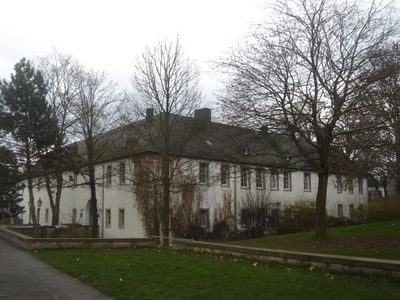
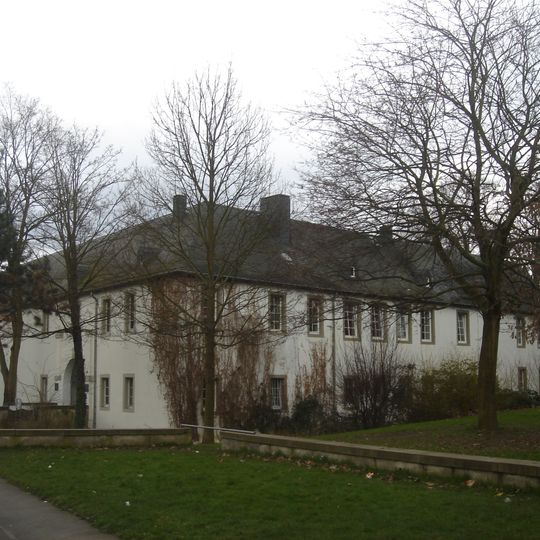
Burg Endenich in Bonn is now only a surviving outer bailey (Vorburg): a long two-storey building with a white facade, a steep dark grey roof with two chimneys and small dormers, rectangular windows in a row and a dark arched doorway on the left. It stands behind a low retaining wall on a grassy slope, with bare trees in front. The main castle was destroyed by the late 17th century.
Burg Endenich is first documented around 1200, when two knights residing there were named in a charter; it may derive from an estate acquired by the Cassius-Stift in 1135. Around 1500 it passed from the knights von Endenich to the vam Huys family, and in 1619 to the Cologne baron Engelhard von Weichs. The main castle (Hauptburg) was destroyed by the War of the Palatine Succession (1688–1697) at the latest; only the outer bailey (Vorburg) survives. Sold in 1690 to Johann Heinrich von Lapp, it was also called Lappenburg; his son Joseph Clemens von Lapp restored and extended it. The von Hymmen family owned it for 132 years from 1830 until the city of Bonn bought it in 1962 for 400,000 DM.
The street beside the former moat was once called "Baachjass" after the Endenicher Bach; it is now Am Burggraben, and the surviving building is numbered 18. Since 1995 the Trägerverein Endenicher Burg has coordinated use of the house by Endenich clubs, and it pushed through the monument listing granted in December 2006.
Burg Endenich stands at Am Burggraben 18 in the centre of Endenich, a short walk from the Endenicher Bach stream that once fed its moat. Only the Vorburg (outer bailey) survives, so there is no main castle or tower to climb; the white two-storey building with its steep grey roof is seen from the street and the adjoining public park and sports ground. The Herrenhaus now holds a branch of the Stadtbücherei and the street wing houses the volunteer fire brigade's Endenich unit, so expect daytime opening rather than a monument to tour.
In the courtyard stands a sweet chestnut over 130 years old with a trunk circumference of more than 4 metres; together with eight other trees in the park it is a registered natural monument. The castle was sold to the city of Bonn in 1962 for 400,000 Deutsche Mark.
The community of curious travelers
AroundUs brings together thousands of curated places, local tips, and hidden gems, enriched daily by 93,848 contributors worldwide.