Burg Schaubeck, Medieval castle in Kleinbottwar, Germany.
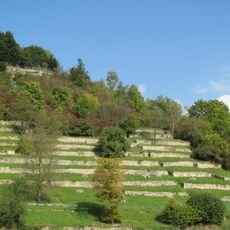
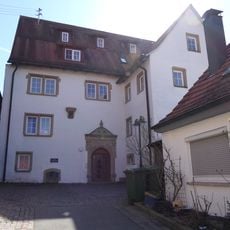
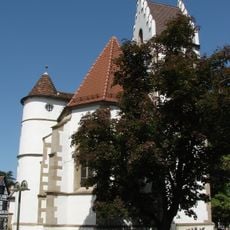
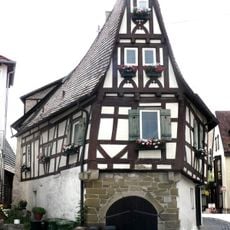
Burg Schaubeck is a castle begun in the 13th century on a steep slope between Steinheim an der Murr and Kleinbottwar, built over the remains of a Roman villa. Its core castle and prominent stair tower survive, and the lower storeys have no windows, preserving its defensive character. Inside, a courtyard is framed by timber-framed facades, while the north and west fronts show painted red and violet corner quoins added between 1749 and 1765.
Burg Schaubeck was first mentioned in a document in 1272, when the ministeriales Bertold and Konrad von Schaubeck, Badenese fiefholders and marshals of Besigheim, began building it on a steep slope over the remains of a Roman villa. In 1392 the castle and the village of Kleinbottwar were sold to Hans von Urbach. From 1480 Dietrich von Plieningen, enfeoffed by Count Eberhard V of Württemberg, began converting it into a palace, work that lasted until 1642.
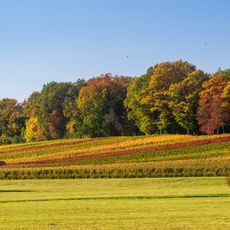
The name Schaubeck comes from the ministeriales Bertold and Konrad von Schaubeck, who began the castle in 1272. Since 1914 the winery Graf Adelmann has operated here; winegrowing in Kleinbottwar is documented as early as 950, and on the castle itself from 1297. The inner courtyard is framed by timber-framed facades.
The castle is privately owned and lived in by the Grafen Adelmann family. The wine sale at the castle is open to the public; the park is accessible only during events such as the wine and culture days held every two years.
The castle stands on the remains of a Roman country house, and the lords of Schaubeck began building it on the steep slope in 1272. Traces of a former tower survive only as wall remnants and foundations, while a clear hollow in the ground suggests the castle once had a moat.
The community of curious travelers
AroundUs brings together thousands of curated places, local tips, and hidden gems, enriched daily by 93,876 contributors worldwide.