Burg Frauenstein, Medieval castle and archaeological site in Weiding, Germany.
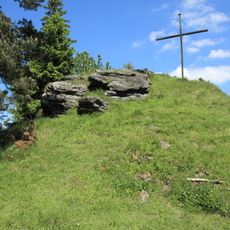
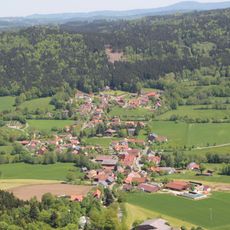
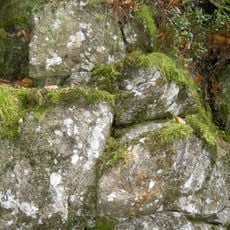
Burg Frauenstein is a ruined hilltop castle on the Frauenstein ridge in the Oberpfälzer Wald, between Gaisthal, Winklarn and Weiding. Only wall remnants and a gate arch survive from the medieval complex, which lies at about 875 metres above sea level, 375 metres above the Ascha valley.
The lordship of Frauenstein, to which Weiding belonged, was bought by Duke Henry of Lower Bavaria from Friedrich Siegenhofer in the second half of the 13th century; the record notes that the area around Weiding, which had a stone church, was largely deserted. In the 14th century the lordship became a fief of the King of Bohemia, followed by the Satzenhofer, Zenger, Fuchs and Murach families. In 1512 Hans von Selbitz, a knight and friend of Götz von Berlichingen, appears as owner. Emperor Rudolf II enfeoffed Andreas Georg von Murach with the two deserted castles of Frauenstein and Reichenstein in 1580.
The name Frauenstein ("Lady's Rock") refers to the hill and the ruined castle, not to a church. The site lies in the Oberpfälzer Wald between Gaisthal, Winklarn and Weiding, near the medieval trade routes to Pilsen and Prague. Only wall remnants and a gate arch remain, and the ruin is listed as a Bavarian heritage monument.
The ruin stands on a side summit of the Frauenstein at roughly 875 metres, 375 metres above the Ascha valley, between Gaisthal, Winklarn and Weiding. Only wall remains and a gate arch survive, so the approach is on foot over unmarked, uneven ground; wear sturdy boots. There are no facilities or fixed visiting hours on site.
The ruin lies on a side summit of the Frauenstein, somewhat higher than the 835 m main peak but lower than the 886 m Signalberg to the southeast; sources give its elevation as 865 or 875 m. The site is recorded as a Bavarian ground monument, and only wall remains and a gate arch survive.
The community of curious travelers
AroundUs brings together thousands of curated places, local tips, and hidden gems, enriched daily by 94,652 contributors worldwide.