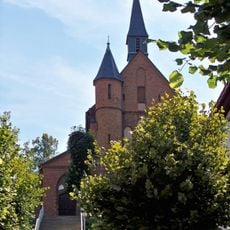
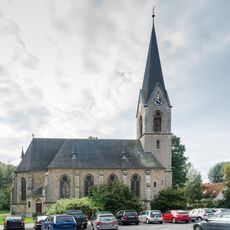
Burg Freckleben, Medieval castle in Aschersleben, Germany.
Burg Freckleben is a Romanesque hilltop castle above the village of Freckleben, with a roughly oval walled area measuring up to 300 by 600 metres, protected on three sides by steep slopes and on the south by three successive ramparts with a double ditch between them. The lower bailey keeps the round Bergfried 1, whose walls are three metres thick and whose inner diameter is four metres; around 1200 the rectangular Bergfried 3 was added, turning octagonal above the fourth storey and fitted with twin Romanesque windows, fireplaces and latrines.
The site's first documented mention is the 762 Fulda foundation book entry as Frekenlevo, though the ramparts may be Carolingian. In 973 Otto II confirmed Freckleben to Archbishop Adalbert of Magdeburg, who died there in 981. In the 12th century the counts of Stade held it; Count Udo was killed at Aschersleben in 1130, and in 1166 Archbishop Wichmann acquired it from Frederick I. Around 1200 Bergfried 3 and the upper castle buildings were erected.
The name Freckleben appears as Frekenlevo in the Fulda foundation book of 762. The site is a protected heritage monument, and the surviving walls and towers are Romanesque work of the period around 1200, built under the archbishops of Magdeburg after Wichmann of Seeburg acquired the estate in 1166.
The outdoor areas are freely accessible at any time. Climbing the bergfried is possible via ladders; the top two floors have rotating spindle ladders, which are unique in Germany.
The top two floors of Bergfried 3 are reached by rotating spiral ladders, described in the source as unique in Germany. The tower itself, built around 1200, is square in its lower four storeys and turns octagonal above, with Romanesque twin windows and a garderobe.
The community of curious travelers
AroundUs brings together thousands of curated places, local tips, and hidden gems, enriched daily by 92,640 contributors worldwide.