Burg Gemen, Medieval castle in Borken, Germany.
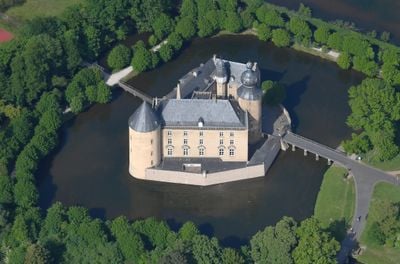
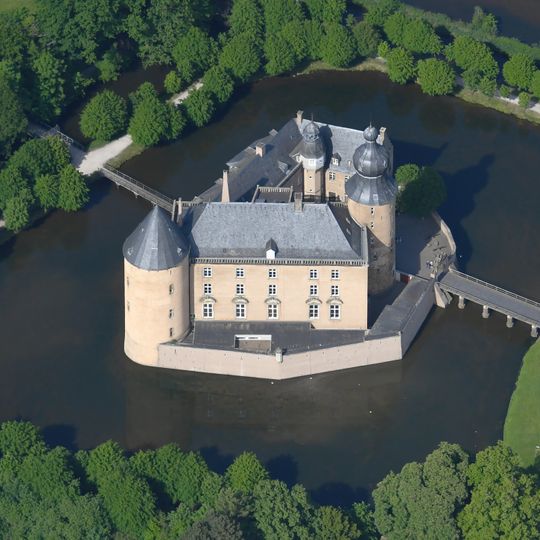
Burg Gemen is a water castle on two islands in the Münsterland parkland, surrounded by a system of moats fed by the Bocholter Aa. Its present appearance dates largely to the early 16th century, when the medieval fortress was rebuilt as a palace. The complex has two round towers with dark domed roofs flanking a three-storey pale-yellow building with a steep slate roof and white-framed windows; a low grey defensive wall wraps around the front and left base, and wooden bridges connect the islands to the banks.
A farm called Gamin was first documented in 962 as a fief of Vreden Abbey; from 1100 the Vredener bailiffs took the name Gemen from their seat. Henry III of Gemen bought the castle from his overlord and had it expanded into a strong fortress by 1411, as a surviving inscription stone naming him and his wife Katharina von Bronkhorst records. In 1700 the domain became imperial immediacy, and Hermann Otto II had the former fortification converted into a palace. In 1822 Baron Johann Ignatz Franz von Landsberg-Velen acquired the complex; his family still owns it.
The name Gemen comes from a farm called Gamin, first recorded in 962 as a fief of the Vreden convent. Since 1946 the Diocese of Münster has leased the castle and runs it as Jugendburg Gemen, a youth education centre with over 200 beds and more than 20 seminar rooms, one of Germany's five largest of its kind.
The complex stands on two islands ringed by a wide system of moats fed by the Bocholter Aa. A wooden bridge on the left and another on the right connect the outer banks to the castle; the low defensive wall with a flat top runs along the front and left base. The site is used by the Diocese of Münster as a youth education centre, so some buildings may be reserved for seminars.
The castle stands on two islands ringed by a wide system of moats fed by the Bocholter Aa, which once flowed through marshland here. In January 1776 the Limburg family retook the complex after soldiers disguised as peasants had seized it, because a severe frost had frozen the moats and made the castle approachable from every side.
The community of curious travelers
AroundUs brings together thousands of curated places, local tips, and hidden gems, enriched daily by 93,754 contributors worldwide.