Burg Sonneberg, Medieval castle in Sonneberg, Germany.
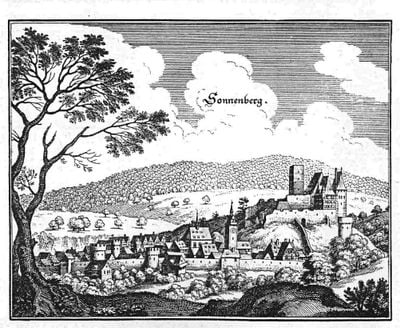
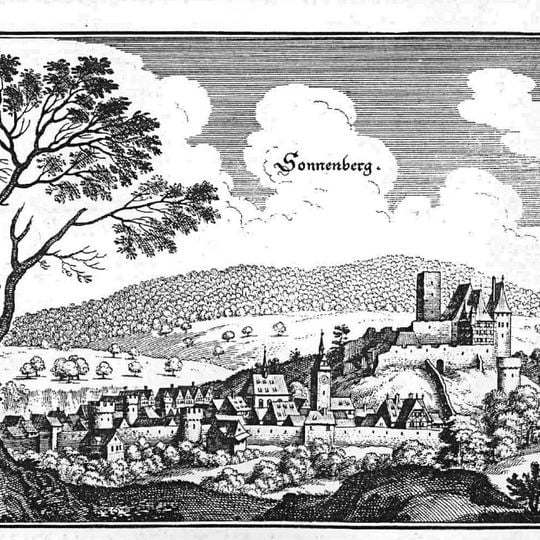
Burg Sonneberg is a stone castle perched on a hilltop overlooking the town of Sonneberg in Thuringia. The structure commands views across the surrounding landscape and the settlement below.
The castle was the seat of the Lords of Sonneberg, who established an administrative centre in the 13th century on territory of the Dukes of Andechs-Merania. In 1317 the County of Henneberg acquired it from the extinct family and granted it as a fief to the Lords of Schaumberg. Countess Jutta of Henneberg pledged it in 1350 to Burgrave Albrecht the Fair of Nuremberg; in 1353 it passed to the House of Wettin and was fortified with a square keep. A castle chapel was consecrated in 1361.
The name Sonneberg is tied to the noble Lords of Sonneberg, who held the castle until their line died out; in 1317 the County of Henneberg acquired it and enfeoffed the related Lords of Schaumberg. The castle chapel was consecrated in 1361. Today the site hosts weddings and corporate events in the Schlossberg event venue.
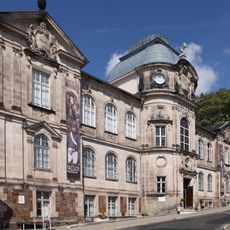
The site stands at 502 m on the eastern edge of the Schlossberg plateau, about 70 m above the old town and the Röthen valley, roughly 1.8 km north of Sonneberg's main station. The complex now operates as an event venue, so the building is generally seen from outside unless a wedding or company event is booked. The tower suite offers overnight stays with a view as far as Upper Franconia.
The castle site was later occupied by a neo-Gothic shooting house built from 1844 to 1850 to plans by Carl Alexander Heideloff, founded by the Augustenverein honouring Duke Bernhard II of Saxe-Meiningen's newborn daughter. Its observation tower was raised to 20 m in 1877. The shooting house was demolished in 1950 and replaced by 1953 with a neoclassical complex.
The community of curious travelers
AroundUs brings together thousands of curated places, local tips, and hidden gems, enriched daily by 94,072 contributors worldwide.