St.-Peter-Kirche, Gothic Revival church in Sonneberg, Germany
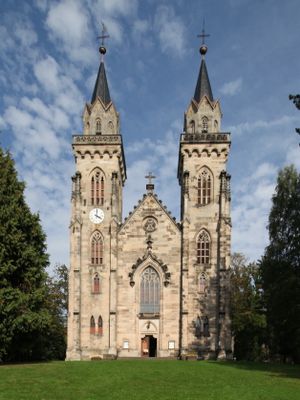
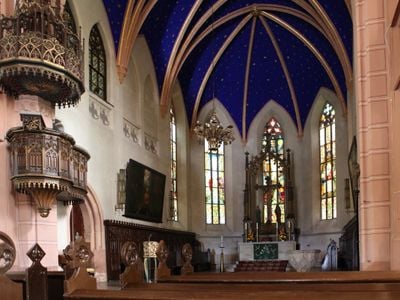
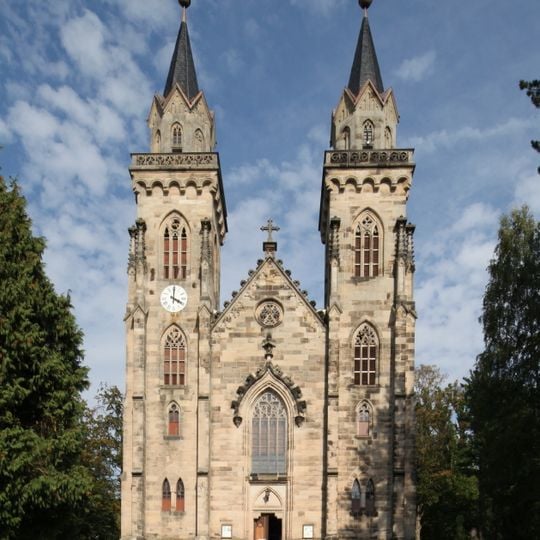
St.-Peter-Kirche is a Gothic Revival church built 1843–1845 to plans by Carl Alexander Heideloff, modeled on Nuremberg's St. Lorenz. Its light grey and tan sandstone facade has twin towers with dark spires and a clock on the left tower; the recessed entrance is topped by a large traceried window and a circular window. Inside, a three-aisled hall with five bays and galleries leads to a polygonal choir; the vault ribs are painted deep blue with gold stars, and three of the five stained-glass windows follow designs by Moritz von Schwind (1892).
A city fire destroyed the previous church in 1840, prompting architect Carl Alexander Heideloff to design this replacement. Construction finished in 1845 and the building has anchored the town ever since.
The church is named after Saint Peter and belongs to the Evangelical Lutheran parish of Sonneberg. Inside, the Gothic altar is framed by a Crucifixion group whose figures are original carvings from Franconia around 1500. Three of the five stained-glass windows were made in Munich in 1892 after designs by Moritz von Schwind.
The church stands at the northeastern edge of Sonneberg, oriented southwest, with the cemetery on the slope above it. The sandstone twin-tower facade faces the town; the entrance sits in the central section beneath the large tracery window. Inside, the nave is flanked by galleries, so the stained-glass windows by Moritz von Schwind are best seen from the pews.
The bells ringing here since 1950 came from Berlin's St. Andreas Church, which burned out in the war and was blown up in 1949. The Sonneberg congregation took them over after the Berlin building was demolished.
The community of curious travelers
AroundUs brings together thousands of curated places, local tips, and hidden gems, enriched daily by 92,700 contributors worldwide.