Burg Liebau, Medieval castle ruins in Pöhl, Germany
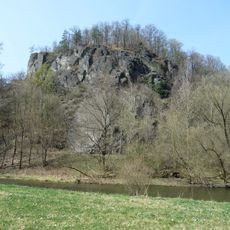
Burg Liebau is the ruin of a spur castle on a flat rock spur on the right slope of the Elster valley, southwest of Liebau in the municipality of Pöhl. Its roughly triangular plateau measures 50 by 30 metres and held a fortified residential tower, a gate tower and a curtain wall with a wall-walk. Two section ditches about 5 metres wide and 2 metres deep were cut into the rock, and a 20 to 25 metre wide neck ditch with a drawbridge protected the east side.
Liebau Castle was first mentioned in 1327 as "castrum lubawe". In the 14th century, the Plauen vogt Heinrich the Elder exchanged the castle, among other properties, with the Wettins. In 1441 it belonged to the Doelau family, who had it rebuilt in Renaissance style between 1500 and 1550. In 1640 Swedish mercenaries plundered it and set the stair tower on fire; after 1742 it fell into ruin.
The place carries a name rooted in Slavic origins that remains part of the local identity today. It stands as a quiet reminder of how noble families shaped the landscape and their connection to this hilltop.
Burg Liebau lies on a flat rock spur on the right slope of the Elster valley, southwest of Liebau in the municipality of Pöhl, about 2 km north of the Pöhl dam. The ruin is a protected archaeological monument, so paths are unmarked and the terrain uneven; sturdy footwear helps. The nearby Burgstall Alt-Liebau, 300 m south of the village at the end of the Rittergut park, is a separate medieval site without documentary mentions.
A striking defensive ditch cuts through the rock itself, the result of extensive labor over time. This carved depression reveals how much effort went into fortifying the position against attack.
The community of curious travelers
AroundUs brings together thousands of curated places, local tips, and hidden gems, enriched daily by 93,601 contributors worldwide.