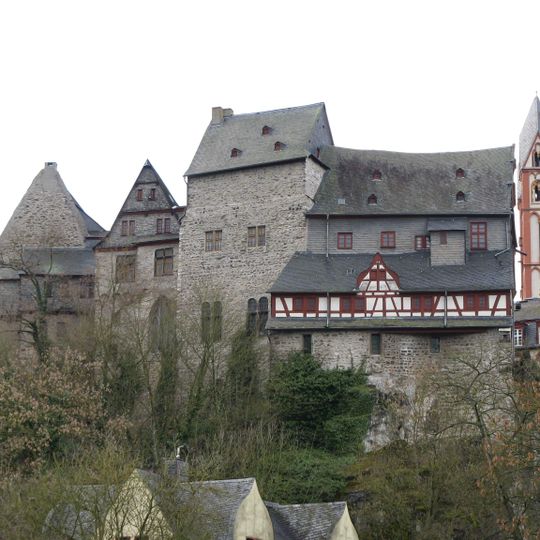
Limburg Castle, Medieval castle on Lahn River hill in Limburg an der Lahn, Germany.
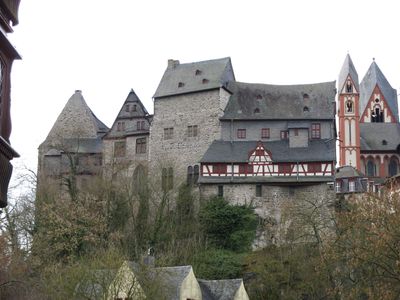
Limburg Castle is a stone fortress rising on a hilltop above the Lahn River, composed of multiple buildings, towers, and fortified walls. The complex forms a defensive stronghold where different sections fit together as a protective system.
A fortification existed on the Domberg by around 800, securing a crossing over the Lahn. In 910 the Conradines founded the St. Georg monastery within the fortress called "Limburc". After the Conradines died out, the castle passed to the House of Isenburg, then in the 14th century to the Electorate of Trier, which enfeoffed the Counts of Leiningen, the Lords of Ysenburg and in the 16th century the Landschad von Steinach. In 1802 it fell to Nassau-Weilburg, in 1866 to Prussia, and in 2000 the town of Limburg bought it for one Deutsche Mark.
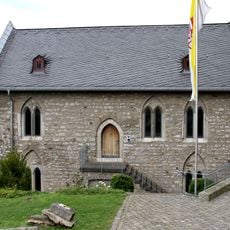
The castle's name comes from the fortress "Limburc" founded in 910 around St. George's monastery, now the cathedral. The Chapel of St. Peter, the oldest surviving part, holds an early Gothic wall painting of St. Christopher from around 1300, its lower half cut by a doorway in the 19th century. The great hall, built after 1379, measures 7.3 by 29 metres and has a large late Gothic fireplace.
Access is from Frankfurter Straße 47, where guided tours of the fortress are offered. Visitors should expect stairs and uneven paths, which are typical when exploring the different sections.
In 1995 the state of Hesse planned to sell the castle to a private investor; 23 citizens founded the Förderverein Limburger Schloss to block the sale, and in 2000 the town of Limburg bought the complex for the symbolic price of one Deutsche Mark. The association later set up a foundation to fund repairs.
The community of curious travelers
AroundUs brings together thousands of curated places, local tips, and hidden gems, enriched daily by 92,729 contributors worldwide.