Burg Lohra, Medieval castle in Großlohra, Germany
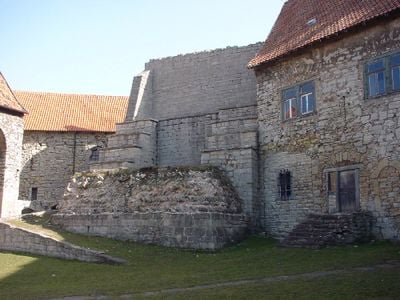
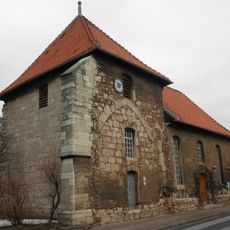
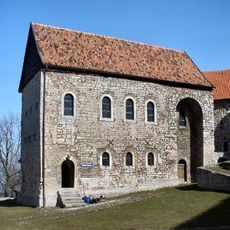
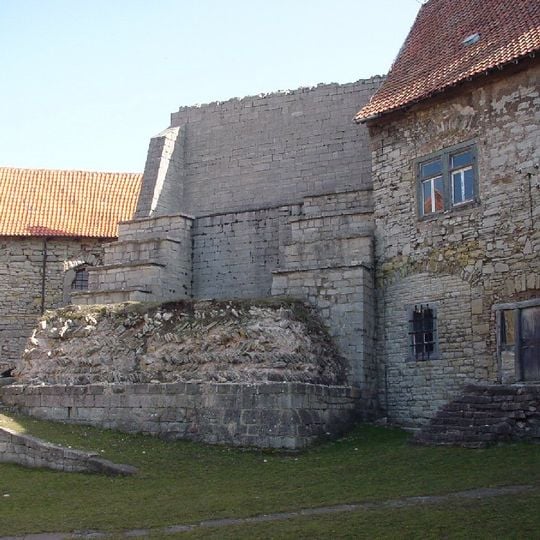
Burg Lohra is a hilltop castle ruin on a mountain spur of the Hainleite near Großlohra, standing at 410 m above sea level. Rough grey stone and lighter rectangular blocks make up the walls; a massive flat-topped wall with a protruding section of pale blocks rises on the left, with a steep reddish-brown tiled roof and a tall arched window attached to the right. A large keep, remains of a palas and an unusually strong ring wall survive, along with the two-storey double chapel.
Burg Lohra was built in the 11th century on a spur of the Hainleite at 410 m above sea level and is first documented in 1116, when Berengar, Count of Lare, appears in a charter. Under Count Ludwig III in the second half of the 12th century the counts, closely tied to the Staufer dynasty, enlarged it with a large keep and a double chapel. The line died out after Ludwig IV failed to return from a crusade to the Holy Land; the counts of Beichlingen took over around 1227, and from 1320 the counts of Hohnstein held the castle until their extinction in 1593.
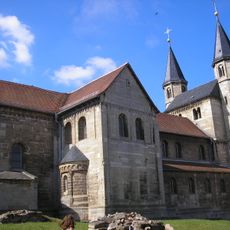
The double chapel is two storeys joined by a central opening: the upper floor served the counts, the lower floor the rest of the castle's inhabitants. Its carved stonework points to masons who also worked at nearby Königslutter. The chapel was restored in 2000 with funds from the Deutsche Stiftung Denkmalschutz.
Visitors should know that the castle sits on a mountain spur and access may vary depending on the season. Wear sturdy shoes since the ground is uneven and some paths are not paved.
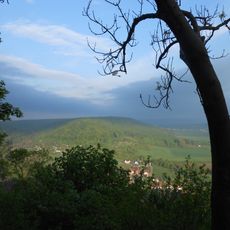
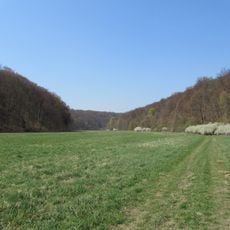
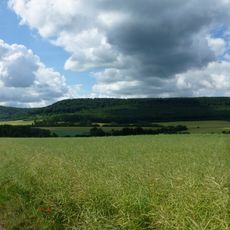
The site sits above 410 meters elevation and offers views across the Hainleite ridge and surrounding protected landscape. This high position was valuable not just for defense but also shaped how residents experienced the land below.
The community of curious travelers
AroundUs brings together thousands of curated places, local tips, and hidden gems, enriched daily by 94,004 contributors worldwide.