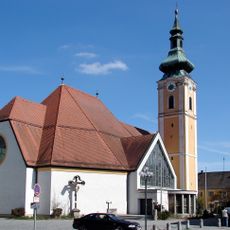
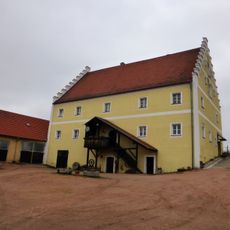
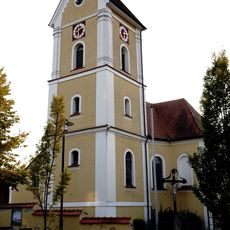
Burg Hof am Regen, Castle ruin in Hof am Regen, Nittenau, Bavaria, Germany
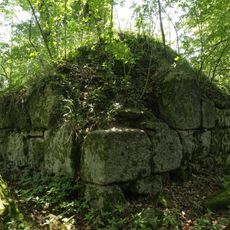
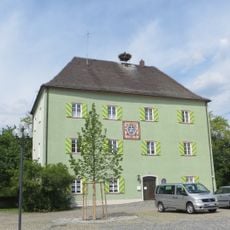
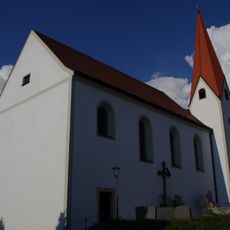
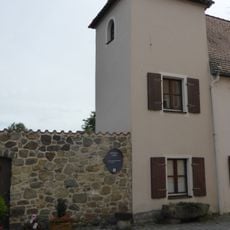
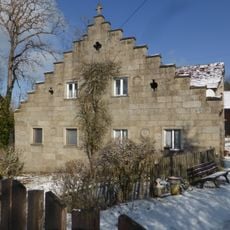
Burg Hof am Regen consists of a southern outer bailey and a northern main castle whose core is a Romanesque church from the 12th century, later raised by two secular storeys to form a tower castle. The restored chapel apse holds frescoes from the second half of the 15th century, and walls up to 2.50 metres thick with several embrasures show the defensive character of the complex.
The Hofer family, ministeriales of the Wittelsbachs, is documented around 1150; a 1340 family dispute split them into the Hofer auf Hof and the Hofer auf Lobenstein, when Otto and Dietrich von Hofer withdrew to Lobenstein. Hiltprand von Hof, named in 1481 and in the oldest Landsassenmatrikel of 1488, ends the line. From 1735 the counts of Thürheim and the lords of Fischbach held castle and Hofmark, passing in 1801 to Wilhelm Karl Graf von Eckart and later to his grandson Graf Du Moulin-Eckart.
The castle's core is a Romanesque church from the 12th century, later raised by two secular storeys to form a tower castle. In the apse of the restored chapel, frescoes from the second half of the 15th century are preserved. The walls reach up to 2.50 metres thick and several loopholes remain.
The ruin stands in Hof am Regen, a district of Nittenau in the Upper Palatinate; the site is recorded as a protected monument and as a Bodendenkmal, so the grounds and buried remains are not to be disturbed. The main castle lies north of the southern Vorburg, and the former moat survives in places as a terrain feature. The three neighbouring castles Hof, Stefling and Stockenfels host the annual Geisterwanderung.
The main castle is essentially a 12th-century Romanesque church that was later raised by two secular storeys for living and working use, turning it into a tower castle. Its walls reach up to 2.50 metres thick and are pierced by several loopholes.
The community of curious travelers
AroundUs brings together thousands of curated places, local tips, and hidden gems, enriched daily by 94,290 contributors worldwide.