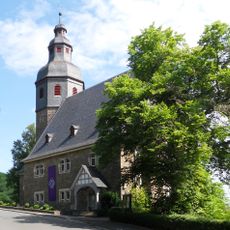
Hohlenfels Castle, Medieval castle in Mudershausen, Germany.
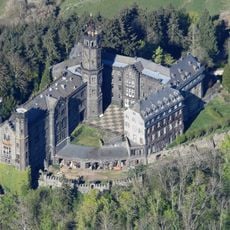
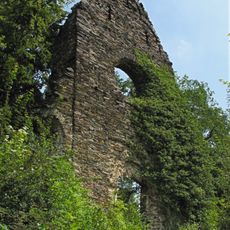
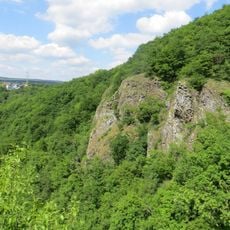
Hohlenfels Castle stands on a 231-metre limestone rock above the Hohlenfelsbach valley, sheer on three sides and rising up to 60 metres. Of the medieval polygonal defences, the five-sided bergfried, parts of the 20-metre-high, two-metre-thick shield wall and the palas survive; the habitable main building dates from 1712–1716. A 12-metre neck ditch cuts off the plateau on the south-west, and a reservoir hewn into the courtyard rock collected rainwater, as the castle had no well.
Gerlach I of Nassau acquired the rock in 1326 and had a manor built below it, from which the village of Hohlenfels grew. Before 1353, Count Johann I of Nassau-Weilburg-Saarbrücken had Daniel von Langenau build the castle to control the Aachen–Nuremberg trade road and the Hessenstraße. The counts of Diez objected, and the 1353 arbitration and the 1363 agreement left the castle as a Nassau fief with Diez rights of access. After 1412 it was divided among heirs, and from 1464 a castle peace treaty regulated its shared administration.
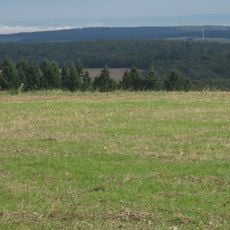
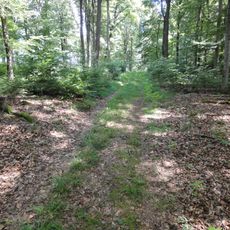
The name reflects the castle's position within rocky terrain, showing how medieval builders chose locations based on natural features. Today, visitors can observe this relationship between the structure and its landscape during a walk around the site.
The castle stands on a limestone rock 231 m above sea level, reachable only on foot; the rock drops steeply on three sides. The grounds open to the public only on a few days in the summer half-year, after reopening in summer 2005. The castle is privately owned and inhabited, so visits are limited to the areas opened on those days.
The castle controlled regional trade routes, and its position provided a key advantage for monitoring goods and travelers passing through. This explains why this precise location was chosen for its construction.
The community of curious travelers
AroundUs brings together thousands of curated places, local tips, and hidden gems, enriched daily by 94,228 contributors worldwide.