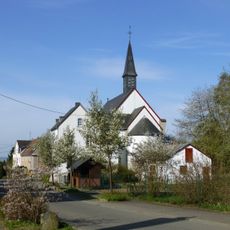
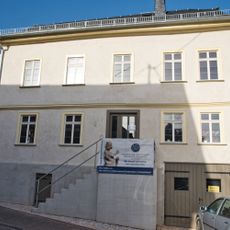
Burg Katzenelnbogen, Medieval castle in Katzenelnbogen, Germany
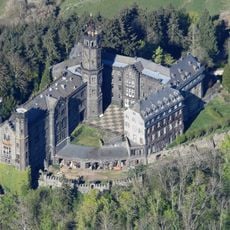
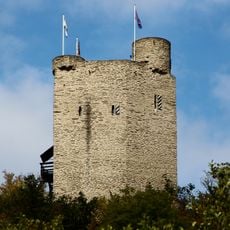
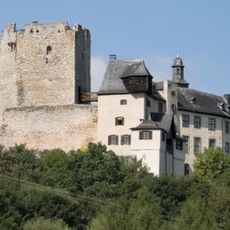
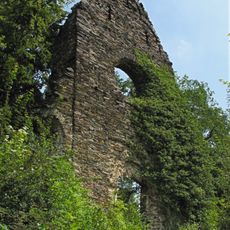
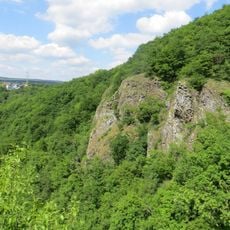
Burg Katzenelnbogen occupies a roughly 50 by 100 metre rock plateau above the town, enclosed by a ring wall. Of the medieval spur castle only the late Gothic gate tower on the west side, large sections of the wall and the well on the east side survive. The main building, often called the Schloss, is a plain three-storey rectangle built in 1584 on the south-east side, with a timber-framed upper floor and an octagonal corner oriel.
The castle was built from 1094 by Diether I, advocate of Bleidenstadt Abbey, and his son Heinrich I, and became the centre and namesake of the County of Katzenelnbogen. Heinrich II was raised here and was made count by King Conrad III in 1138. A complete rebuild took place in 1371 under Wilhelm II, and after a fire in 1540 new buildings were added in 1584 and 1613.
The name Katzenelnbogen has two proposed origins: from Latin Cattimelibocus, meaning "Hessian mountain" (the Chatti were the tribe of today's Hesse), or from a settler named Chazo at the bend (Ellenbogen) of the Dörsbach stream that runs through the town. The counts took the castle as their family name.
The castle is privately owned and not open to visitors. The former neck ditch on the east side is largely filled in and now serves as the hotel's parking lot. The grounds measure roughly 50 by 100 metres on a rock plateau above the town.
The name Katzenelnbogen may derive from Latin Cattimelibocus, meaning "Hesse mountain", linking the Chatten tribe to the Melibocus peak; a rival explanation points to Chazo's settlement at the bend (Ellenbogen) of the Dörsbach stream. The castle's medieval core was largely destroyed in the 1540 fire, so the open inner courtyard is now empty.
The community of curious travelers
AroundUs brings together thousands of curated places, local tips, and hidden gems, enriched daily by 93,185 contributors worldwide.