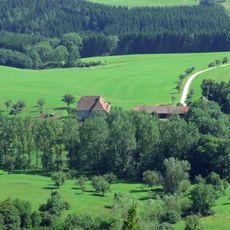
Burg Hossingen, Medieval castle ruins in Hossingen, Germany.
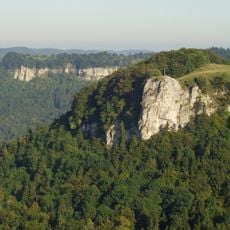
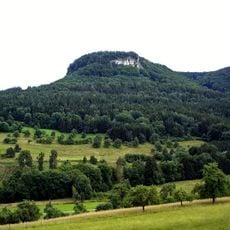
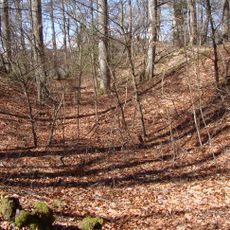
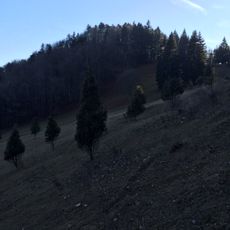
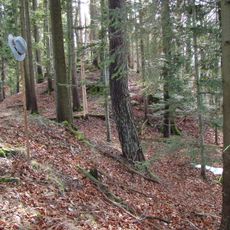
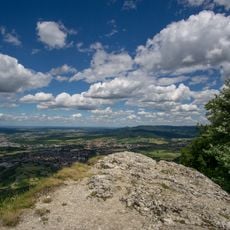
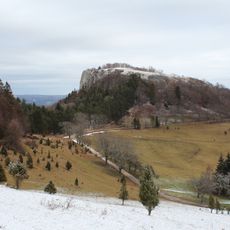
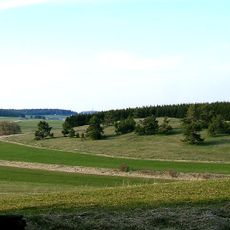
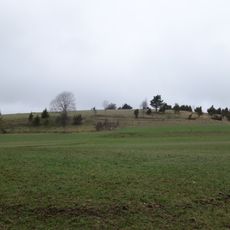
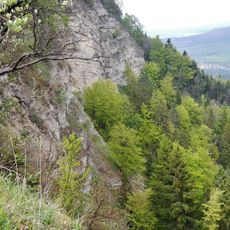
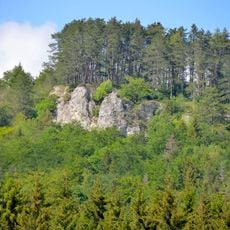
Burg Hossingen is a castle set on a ridge at about 830 meters in elevation, where remnants of medieval walls and two deep defensive ditches are still visible today. The foundations scattered across the site mark where buildings once stood during its active years.
The castle was built in the 12th century as a strategic stronghold by officials serving the Counts of Hohenberg. It passed to Württemberg in 1418 and gradually declined from that point onward.
The name Burtel, used locally for the castle, may derive from the coat of arms of Mömpelgard, showing two golden barbels, since the Counts of Württemberg and Mömpelgard owned the castle from 1418. Local historian Hermann Krauß instead considered a derivation from Burgtal plausible. A 1521 manuscript can be read as Bardenstein, Burtelstein or Bartenstein.
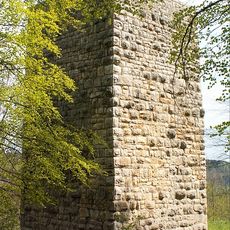
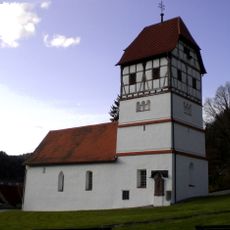
The site lies about 750 metres south-west of Hossingen's church, reached via the Schwäbische Albstraße toward Unterdigisheim. Two neck ditches and a few wall remains survive on the spur; the ground is uneven, so sturdy footwear helps. The barriers on the right side of the valley are preserved apart from the watchtower.
The name may derive from the coat of arms of Mömpelgard, showing two golden barbels, since the Counts of Württemberg and Mömpelgard owned the castle from 1418. A 1521 manuscript renders the name as Bardenstein, Burtelstein or Bartenstein, and local researcher Hermann Krauß considered a derivation from Burgtal likely.
The community of curious travelers
AroundUs brings together thousands of curated places, local tips, and hidden gems, enriched daily by 93,939 contributors worldwide.