Burg Kakesbeck, Moated castle in Bechtrup, Lüdinghausen, Germany
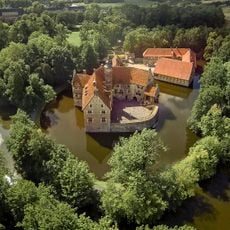
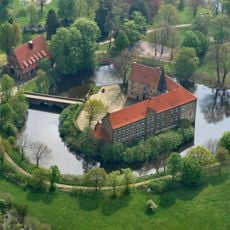
Burg Kakesbeck is a moated castle in Lüdinghausen, in the Münsterland region of North Rhine-Westphalia, with its oldest parts dating to the 13th century. The main building is flanked by several defensive towers and surrounded by a system of water-filled moats that define the overall layout of the estate.
Kakesbeck is first recorded in the 9th-century registers of Werden Abbey, whose ministerials called themselves von Kakaresbeki. Around 1100 the estate passed by exchange to the Counts of Dale, who built a motte north of the buildings around 1120. In 1322 Bernhard von Wulfheim, droste of Vischering, bought it and enlarged it into a two-island castle; in 1384 it passed by marriage to the von Oer family, and in 1738 the Droste zu Vischering bought it with 80 dependent farms.
The castle chapel was demolished in 1868; its reconstruction began in 1988 on the known old foundations and was consecrated in 2014 as an ecumenical chapel. Painters Mathes Schweinberger and Andreas Raub decorated the interior with 40 portraits of exceptional figures, the "Saints of Kakesbeck", of Protestant, Catholic and Jewish faith. The chapel is open for visits and weddings.
The castle stands at Bechtrup 63, five kilometres north of Lüdinghausen's centre, east of the L 835 on the Stever. The exterior can be viewed at any time; an interior visit must be arranged in advance. The site is privately owned.
Dendrochronological dating of the oldest pile foundations at the shield wall gave the year 830. Excavations led by Alfred Zeischka also uncovered parts of the former ring wall and foundations of a defensive wall from around the 13th century.
The community of curious travelers
AroundUs brings together thousands of curated places, local tips, and hidden gems, enriched daily by 93,949 contributors worldwide.