Burgruine Hofberg, Castle ruin in Greding, Germany.
Burgruine Hofberg is a medieval castle complex near Greding featuring five corner towers and defensive walls built over several periods. The site contains a gatehouse and chapel remains, with two separate wall rings that were added at different times to strengthen the fortification.
The castle was founded in the early 13th century by the Lords of Mässing and passed to the Teutonic Order in 1285 after the family line ended. Later, in the final decades of the 15th century, it underwent major defensive reinforcements under episcopal control.
The name Mässingen, first recorded in 1068, belongs to the family that built the castle and gave Obermässing its name. In 1525 the Mässinger Haufe, a local peasant band, seized and plundered the castle without destroying it. Since around 2000 the Verein für Kultur- und Heimatpflege Greding has carried out restoration work.
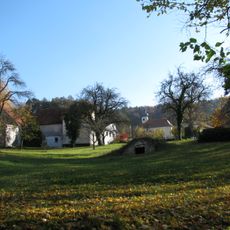
The castle sits halfway up the south-east slope of the Hofberg, with steep drops to the south and east; the approach is from the north through the outer bailey, whose defensive ditch is now filled in. The gatehouse of 1490, a two-storey gabled building with slit windows, stands by the courtyard of the outer bailey. The inner bailey is reached from there; the terrain is uneven and partly overgrown.
The five-sided main bailey dates from around 1490, when Prince-Bishop Wilhelm von Reichenau had a new ring wall with five round, half-open corner towers built 8–10 m outside the older wall. The towers' embrasures were cut for hook guns, an early firearm.
The community of curious travelers
AroundUs brings together thousands of curated places, local tips, and hidden gems, enriched daily by 92,825 contributors worldwide.