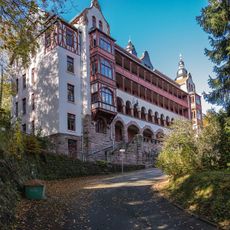
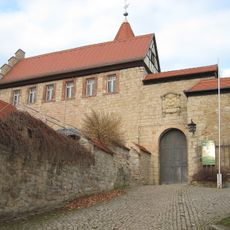
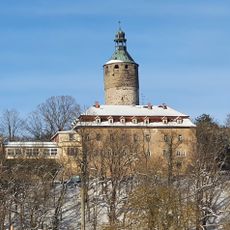
Burg Tannroda, Medieval castle in Bad Berka, Germany.
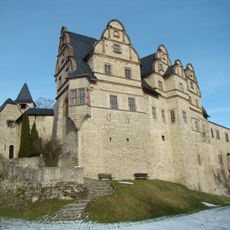
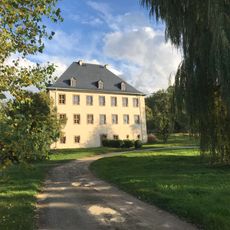
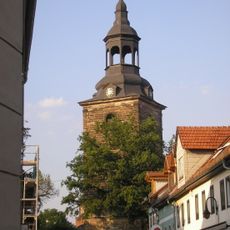
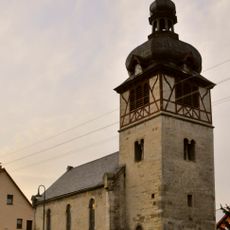
Burg Tannroda, also called Blaues Schloss, stands on the 300-metre Lindenberg above the right bank of the Ilm at the western edge of Tannroda. Its irregular main castle with outer bailey is dominated by a 22-metre round bergfried on a square masonry base with bevelled upper corners, now used as a viewing tower. Behind the tower are the remains of the residential building with a round-arched entrance; the economic buildings lie in the outer area.
The castle was built between 1100 and 1200 and served as the seat of the lords of Tannrode until its destruction in 1465 by citizens from Erfurt and Weimar. The site was later rebuilt in modified form, but much of the original defensive structure remained lost.
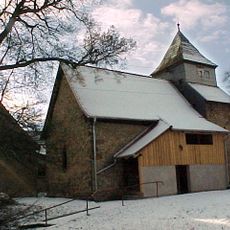
The Thuringian Basket-Making Museum occupies a former service building of the castle, run by the local heritage association. Its exhibits cover Tannroda's first documentary mention in 1115 and its town rights of 1403, the castle's owners, and a small display on Carl-Alexander von Gleichen-Rußwurm, Schiller's last descendant. Basket weaving died out in the town only in 1990; the museum also holds Henry van de Velde's designs for furniture made by Tannroda basket-makers.
The round tower and interior areas are open to visitors during daytime hours, allowing access via stairs for views over the surrounding landscape. Guided tours are available and should be arranged in advance for a more informative experience.
The Red Castle burned down in 1775 together with the keep, but its ruins were not cleared until 1824, so the two-part complex stood as a ruin for nearly fifty years. The keep itself, a 22-metre round tower on a square masonry base with chamfered upper corners, now serves as an observation tower.
The community of curious travelers
AroundUs brings together thousands of curated places, local tips, and hidden gems, enriched daily by 92,629 contributors worldwide.