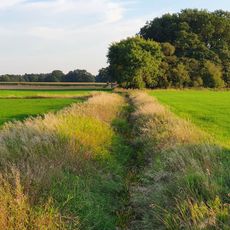
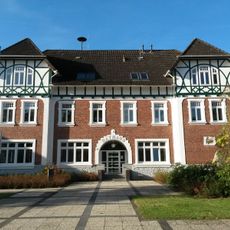
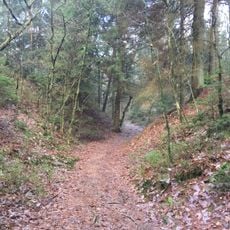
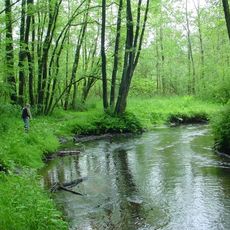
Burgwall Hollenstedt, Reconstructed ring wall of a 9th-century lowland castle in Hollenstedt, Germany
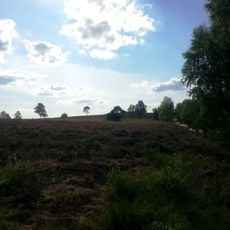
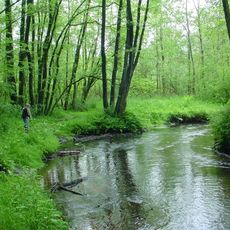
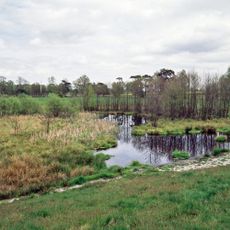
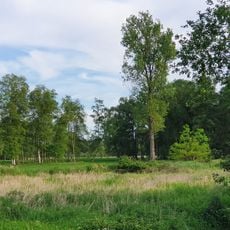
Burgwall Hollenstedt is a reconstructed ring wall on a sandy peninsula on the west bank of the Este, about 1.5 km south of Hollenstedt. The walled area has an inner diameter of 80 m (about 0.5 ha), with a berm and a 5 m wide, 1 m deep outer ditch; the total diameter is 120 m. The original wall was 8 m thick and up to 4 m high, built of wood and earth faced with heather sods, and topped by a wooden palisade about 340 cm high.
Built in the late 9th century, the ringwork stood for only a few decades. Dendrochronology on recovered timbers points to 892, suggesting construction by the counts of Stade, supported by the field name Grevenhorst. A written mention of 804 refers to Charlemagne's summer camp before the castle existed; the identification with the rampart is now rejected. Repairs around 950 and a fire of unknown origin ended its use.
The name Karlsburg comes from a mistaken link to Charlemagne's 804 summer camp in the Frankish Royal Annals; scholars now reject this, as dated timbers show the wall was built around 892, likely by the Stade counts, whose presence is echoed in the local field name Grevenhorst (counts' hill).
The site is open year-round and can be explored on foot, with information boards at several spots explaining the history and layout. Sturdy footwear is recommended since the ground is uneven and can become slippery after rain.
The rampart was a wood-earth construction faced with heather sods, its crown carrying a palisade about 340 cm high, with casemate-like timber buildings set against the inner face. Dendrochronology dated several recovered timbers to 892, pointing to construction by the Stade counts rather than the Slavic gord once assumed.
The community of curious travelers
AroundUs brings together thousands of curated places, local tips, and hidden gems, enriched daily by 93,868 contributors worldwide.