Burschenschaftsdenkmal Jena, Memorial and statue at the University of Jena, Germany
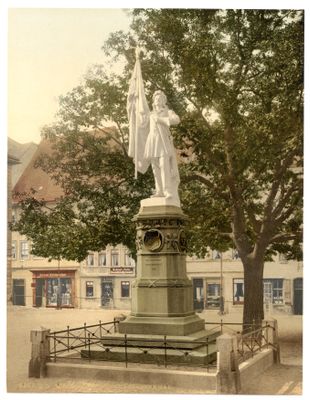
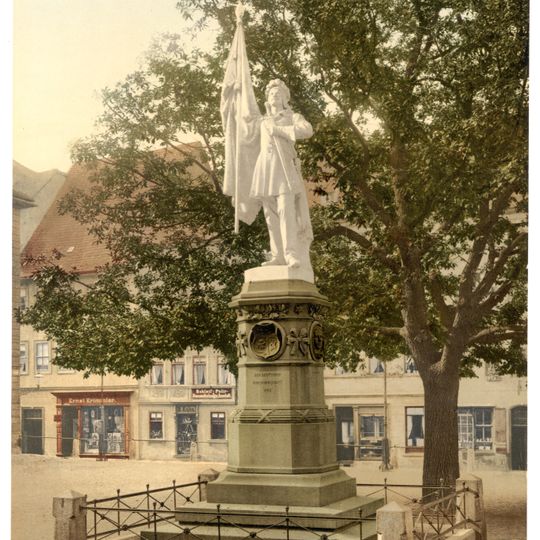
The Burschenschaftsdenkmal Jena is a 5.50-metre neo-Renaissance monument by Weimar sculptor Adolf Donndorf, erected in 1883. Its 3.30-metre Carrara marble figure of a student in the Altdeutsche Tracht banned in 1819 holds the Urburschenschaft flag and a sword inscribed "Fürs Vaterland". The Jena limestone base has an oak-leaf frieze and four bronze medallions showing the Urburschenschaft coat of arms and founders Karl Hermann Scheidler, Heinrich Riemann and Carl Horn.
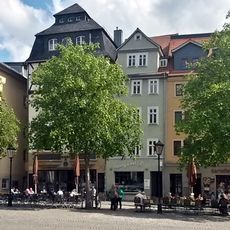
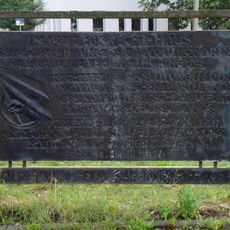
The monument was inaugurated on 12 June 1883 on Eichplatz, in front of the Burschenschaft oak planted in 1816, to mark the founding of the Urburschenschaft on 12 June 1815. The idea arose in 1867 as a grave monument for Karl Hermann Scheidler; after 1873 it was expanded to honour Heinrich Riemann, Carl Horn and the Burschenschaft itself. Removed and stored in 1947, it has stood before the university's main building on Fürstengraben since 1951.
The flag in the student's right hand bears the inscription "Von den Frauen und Jungfrauen zu Jena am 31. März 1816", recording the women of Jena who donated it. The sword reads "Fürs Vaterland". The oak-leaf frieze and the four bronze medallions showing the Urburschenschaft coat of arms and its founders Scheidler, Riemann and Horn carry the student movement's symbols.
The monument is accessible year-round and stands on the university campus. From November to April, it receives a protective covering to prevent weather-related deterioration.
The central figure was carved from a single block of Carrara marble, demonstrating the sculptor's technical mastery. This material came from Italy and was the preferred choice for monumental works in the 19th century.
The community of curious travelers
AroundUs brings together thousands of curated places, local tips, and hidden gems, enriched daily by 93,637 contributors worldwide.