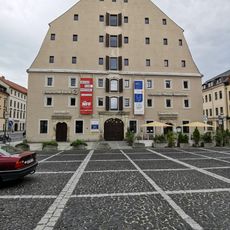
Christian Weise Library, Public library in Zittau, Germany.
The Christian Weise Library in Zittau is split between two sites: the scientific old holdings, including the seven Zittau missals and the Lusatica collection, are housed in a converted building on the former barracks ground of the dissolved NVA officers' academy, while the public lending library has occupied the renovated Marstall since 2002. The Heffterbau, a Baroque hall with the Heffter gable added in 1709, served as the historic library room.
The library's origins trace to 1564, when the Zittau council took over part of the book collection of the secularized Franciscan monastery. Christian Weise led the council library from 1678 until his death in 1708 and greatly expanded it. In 1709 the collection moved into the Baroque hall of the Heffterbau, where it survived the town's destruction in 1757. It has borne Weise's name since 1954.
The library's name honours Christian Weise, who led the Ratsbibliothek from 1678 until his death in 1708 while serving as rector of the Zittau Gymnasium. A 1992 symposium in Zittau marked the 350th anniversary of his birth, and a commemorative volume appeared in 1993. Since 1999 the library has taken part in the Euroregion Neisse library working group, cooperating with partners in Poland and the Czech Republic.
The library is split across two sites: the public lending library moved in 2002 into the renovated Marstall, while the scientific historical holdings have been housed since 2001 in a converted building on the grounds of the former NVA officers' academy. The old Bahnhofstraße location was given up. Visitors should establish which site holds the material they want before setting out.
Among the 45,000 volumes of the historical collection is the only certified copy of the Majestätsbrief, made after the original was cut up; the library also keeps the Codex Zittaviensis and seven Zittau missals from the 15th and 16th centuries. In 1958 a hymnal psalter of 1618 returned to Prague, its last page bearing the names of Protestants executed in 1618.
The community of curious travelers
AroundUs brings together thousands of curated places, local tips, and hidden gems, enriched daily by 94,389 contributors worldwide.