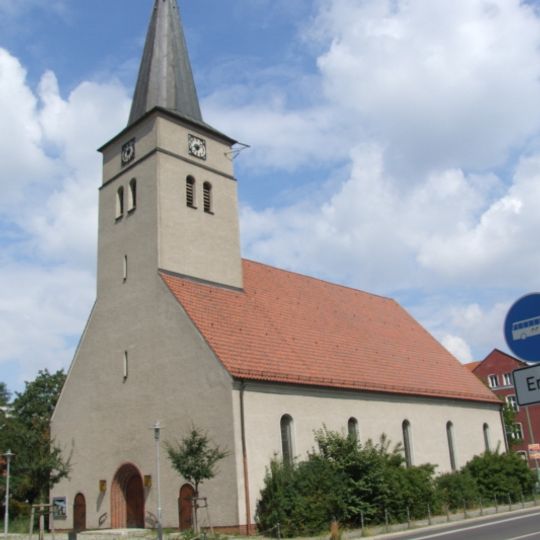
Dorfkirche Friedrichsfelde, Protestant church in Friedrichsfelde, Lichtenberg, Germany
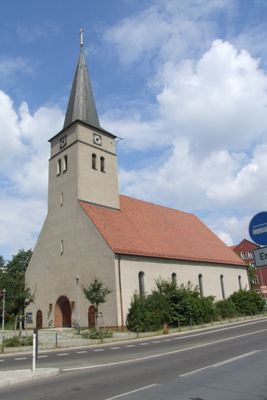
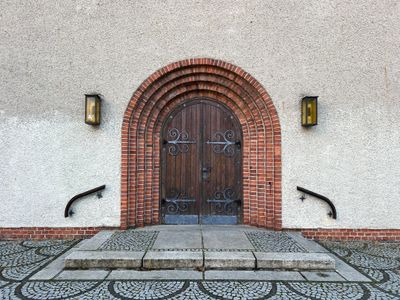
Dorfkirche Friedrichsfelde is a rectangular hall church with a square roof turret, rebuilt in simplified form in 1951/1952 by architect Herbert Erbs from the surviving nave walls, beams and bricks of the 1887–1890 neo-Romanesque building. It has a rendered exterior, a round-arched stepped portal and simple round-arched windows, plus a sacristy annex. The altar wall facing Am Tierpark was set back about twelve metres during the rebuild.
Low German settlers founded Rosenfelde around 1230 and built a fieldstone church with a west tower, nave and recessed choir; village and church were first documented on 2 April 1265. Court architect Martin Heinrich Böhme enlarged and baroquified it between 1718 and 1728, and around 1779 the windows were enlarged and an organ by Ernst Julius Marx installed. A neo-Romanesque replacement rose beside it from 1887 to 1890, the old church was demolished in 1891, and after the 1943 air mine and 1945 fire the ruin was rebuilt in simplified form by Herbert Erbs, consecrated at Advent 1952.
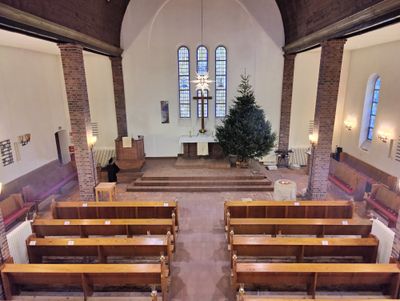
The village was founded as Rosenfelde around 1230 and only later took the name Friedrichsfelde; the church is one of four belonging to the Paul-Gerhardt congregation. Its high-baroque pulpit altar was given away in 1890 to the village church of Petershagen, and its organ went to neighbouring Eggersdorf. A panel inside shows an earlier view of the church and photographs of the war damage.
The church stands on the protected village green at the corner of Alfred-Kowalke-Straße and Am Tierpark in Friedrichsfelde. Because the rebuilt altar wall was set back about twelve metres from the street, the entrance side faces Am Tierpark rather than sitting on the old building axis. Inside, original architect's drawings by Herbert Erbs show the surviving parts and the changes made in 1951/52.
The two churches stood side by side for a year: the neo-Romanesque building was consecrated in 1890, and the medieval predecessor was only demolished in 1891, giving painters and photographers a rare double motif. Its high-baroque pulpit altar went to the village church of Petershagen as a gift in 1890, while the organ moved to neighbouring Eggersdorf.
The community of curious travelers
AroundUs brings together thousands of curated places, local tips, and hidden gems, enriched daily by 94,524 contributors worldwide.