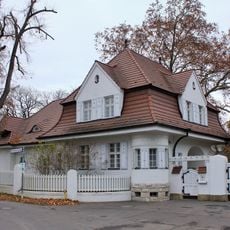
Gatow village church, Heritage church in Gatow, Spandau, Germany.
Gatow village church consists of four distinct sections built in different periods, visible in the contrast between fieldstone and plastered brickwork. The fieldstone nave began in the early 14th century as a narrower choir, later extended west in the 15th century. A wooden roof turret was added in 1844–1846, a plastered altar house in 1869, and a sacristy in 1913. The main portal in the west wall dates from 1935, refashioned in 1953 as a fieldstone pointed-arch copy.
The fieldstone nave was begun in the early 14th century, when Gatow belonged to the Benedictine convent of Spandau. In the 15th century the core was raised and extended west into a single-hall church. After repairs in 1723, 1741 and 1816, a boarded roof turret followed in 1844–1846, a plastered altar house in 1869 and a sacristy in 1913. Secularisation brought the village to Elector Joachim II in 1558.
The village belonged to the Benedictine convent of Spandau until the secularisation of 1558 brought it under Elector Joachim II and the Spandau office. From 1539 the church has been Protestant and is still used for services today. Gatow, Kladow and Groß Glienicke formed one parish until the Berlin Wall was built; in 1966 Gatow again became an independent village church community, restoring the situation that had existed around 1500.
The church is easily accessible by bus from Spandau, with direct connections to Gatow village. Visitors should check local opening times, as the building is primarily open during services and community events.
The bronze bell in the tower dates from the 14th century; two cast-iron bells from the Franz Weeren ironworks were added in 1953. The weather vane's year 1350, also from 1953, was chosen arbitrarily rather than taken from records.
The community of curious travelers
AroundUs brings together thousands of curated places, local tips, and hidden gems, enriched daily by 94,249 contributors worldwide.