Dinosaurierfährten von Barkhausen, Prehistoric fossil tracks in Bad Essen, Germany
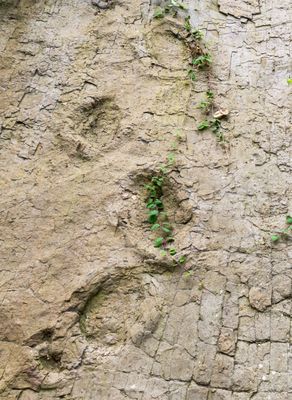
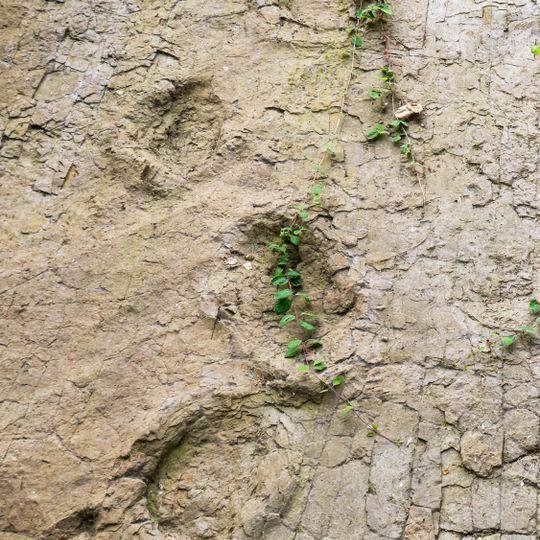
The Dinosaur Tracks of Barkhausen are fossilized footprints from several large dinosaurs of the Jurassic period, embedded in a natural rock wall. The rocks clearly show the marks left by nine sauropods and two large meat-eaters that passed through this area 150 million years ago.
The quarry owner Heinrich Vehring found the first prints in the stone in 1921; the geologist Walther Klüpfel recognised them as ichnofossils, and Max Ballerstedt, a teacher at the Adolfinum in Bückeburg, studied them scientifically. Only some sauropod tracks were exposed at first, and further traces, including the theropod ones, were found later. The quarry was protected in 1982, more footprints were uncovered in 1983, and in 2019 the site was named a Nationaler Geotop.
The sauropod tracks were named Elephantopoides barkhausenensis in 1974 by Kaever and de Lapparent, meaning "elephant foot from Barkhausen"; they were the first European sauropod tracks to receive a scientific name. Since 2000 a glass roof has protected the rock face, and two life-size replicas of the possible track-makers stand beside it.
The rock face is steeply angled and platforms allow you to view the various footprints from different angles. The site is accessible year-round, though rain can sometimes make the paths slippery.
The sauropod prints were named Elephantopoides barkhausenensis in 1974, meaning "elephant foot from Barkhausen"; they were the first European sauropod tracks to receive a scientific name. The hind-foot impressions measure 32 to 38 cm across, with a step length of about 1.5 m. Because claw marks are missing, it cannot be told whether young or adult animals made them.
The community of curious travelers
AroundUs brings together thousands of curated places, local tips, and hidden gems, enriched daily by 93,530 contributors worldwide.