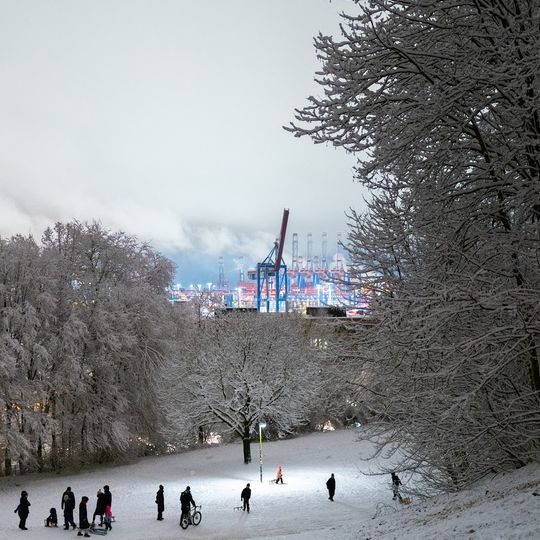
Donners Park, Public park in Ottensen, Germany
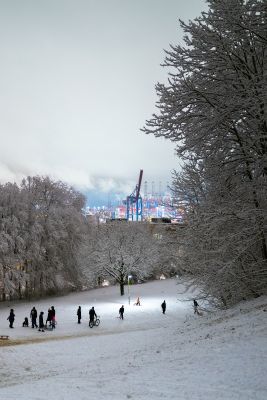
Donners Park is a large green space in Altona with walking paths, open grassland, and elevated lookout points that frame views of the Elbe River. The grounds connect the Ottensen and Övelgönne neighborhoods through its layout and provide different areas for strolling and stopping to enjoy the surroundings.
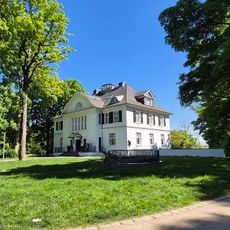
The park's story began in the late 1700s when three merchants purchased a private estate and transformed it into a recreational space. A castle was added in the 1800s to serve as a focal point, though it was damaged and eventually lost during the wars of the following century.
The name comes from the Altona banking and merchant family Donner, who owned the estate until the city of Altona bought it on 7 December 1911 and opened it to the public. Helene Donner (1819–1909), who lived here after her husband Bernhard's death, extended the park and founded the Helenenstift. The park is still used as a lawn for sunbathing and a sledding hill, and as a direct route between Ottensen and Övelgönne.
The park lies directly on the Geest slope between Elbchaussee and the Elbe, and serves as a direct route on foot between Ottensen and Övelgönne. A footbridge connects it eastward to the Heine-Park, while to the west it merges into the Rosengarten. The Liegewiese and the Rodelberg are still in use today.
The garden was redesigned by French architect Joseph Ramée for Georg Heinrich Sieveking; it was his first commission in northern Germany and made his name. In 1927 mayor Max Brauer brought a Heinrich Heine sculpture by Ludvig Hasselriis to the park after its odyssey; it now stands in Toulon.
The community of curious travelers
AroundUs brings together thousands of curated places, local tips, and hidden gems, enriched daily by 93,965 contributors worldwide.