Schloss Erxleben, Medieval château in Erxleben, Germany.
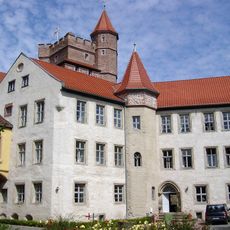
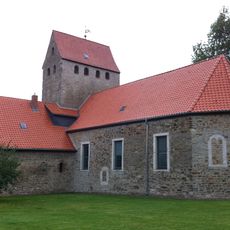
Schloss Erxleben is a castle complex in Erxleben that grew from a medieval lowland moated castle with ramparts on the old military road between Braunschweig and Magdeburg. Its central building is the Vorderschloss from the 15th century, which contains the Neue Kemenate of 1430 and was altered after a fire in 1526. A wall divided the complex after the 1554 inheritance split between the white and black lines of the von Alvensleben family.
Erxleben began as a lowland castle with moats and ramparts, possibly founded shortly after 1100 on the old military road between Braunschweig and Magdeburg. Archbishop Wichmann of Magdeburg bought it in 1166; Emperor Otto IV destroyed it in 1214 or 1218. By 1282 it belonged to the von Alvensleben family. In 1441 the dukes Heinrich II of Braunschweig and Otto IV of Lüneburg shot it with artillery and burned it without taking it; the pledge was redeemed in 1505 by Busso IX von Alvensleben.
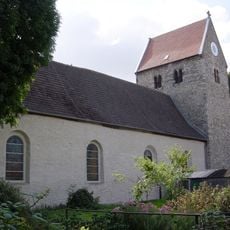
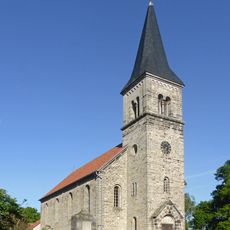
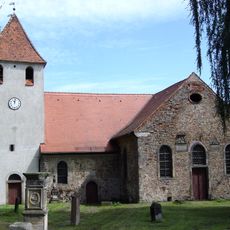
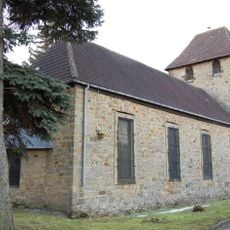
The chapel of St. Godehard, built 1562–1580 for both Alvensleben lines, holds tombs from 1582 to 1928, among them Graf Albrecht von Alvensleben-Schönborn. Its organ by Heinrich Herbst (1709/1710) has 24 stops on two manuals and pedal, restored 2015–2019. The burial vaults are cut several storeys deep into the rock.
The complex lies in Erxleben, Saxony-Anhalt, about 14 km southwest of Haldensleben, on the old military road between Braunschweig and Magdeburg. The Schlosskirche St. Godehard, rebuilt from 1562 to 1564, is the most visible part; its organ was restored between 2015 and 2019. The surrounding Börde plain is flat, so the site is easy to reach on foot from the village.
The castle was a lowland moated fortress with ditches and ramparts, not an elevated stronghold. Its strategic value came from its position on the old military road between Braunschweig and Magdeburg, at the junction of important routes inside the Archbishopric of Magdeburg. In 1441 the dukes Heinrich II of Braunschweig and Otto IV of Lüneburg shot it with artillery and burned it, but could not take it.
The community of curious travelers
AroundUs brings together thousands of curated places, local tips, and hidden gems, enriched daily by 94,511 contributors worldwide.