Schloss Altenhausen, Heritage château in Altenhausen, Germany
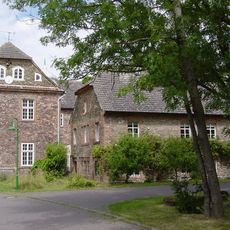
Schloss Altenhausen consists of a round inner bailey holding a Renaissance dwelling house, to which a tall neo-Gothic palas with an integrated bergfried is attached. West of the bailey lies a farmyard whose late Gothic, Baroque and Historicist buildings stand on the medieval ring wall. The main approach from the village passes through the Alexandertor, a rendered brick gate dated 1671, and then the Andreastor, where the rebates of a former drawbridge are still visible.
The castle grew out of a lowland fortification built in the 11th or 12th century and first documented in 1303, after the counts of Altenhausen had died out. Magdeburg troops destroyed it in 1351 during a feud with the city of Magdeburg; it was rebuilt and passed in 1485 to the von der Schulenburg family, who held it until land reform expropriated them in 1945. A fire in 1625 during the Thirty Years' War caused heavy damage, and the neo-Gothic addition was completed in 1901 to designs by Ferdinand Schorbach.
The Alexandertor, the brick gate leading from the village into the castle grounds, is dated 1671 and named after Alexander von der Schulenburg (1616–1681), who rebuilt the burned-out wings. Above the arch are an inscription panel, the Schulenburg coat of arms and, to the right, the Bismarck arms. Inside, a Rittersaal and stuccoed salons survive; the castle now houses a youth hostel and hotel, and the Saxon-Anhalt symphonic music school orchestra rehearses here.
The main entry from the village is the Alexandertor in the south, a brick gate dated 1671; beyond it a forecourt leads through the Andreastor gatehouse, where the grooves of a former drawbridge are still visible, onto the economic yard. A narrow footbridge crosses the moat to the church. The grounds are now run as a youth hostel and hotel, so visitors should confirm access before arriving.
The narrow footbridge over the moat to the church is easy to miss. The round core of the inner castle survives, and the Andreastor gatehouse still shows the rebates of a former drawbridge beside a small wicket door. The Alexandertor of 1671 bears the Schulenburg coat of arms and, to its right, the Bismarck arms.
The community of curious travelers
AroundUs brings together thousands of curated places, local tips, and hidden gems, enriched daily by 92,656 contributors worldwide.