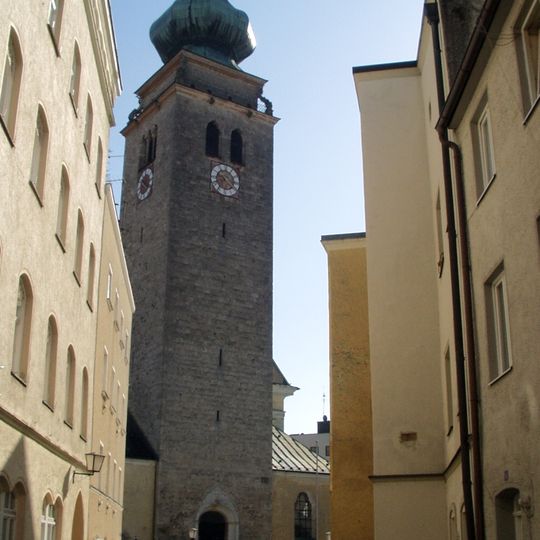
St. Nikolaus, Parish church in Mühldorf am Inn, Germany.
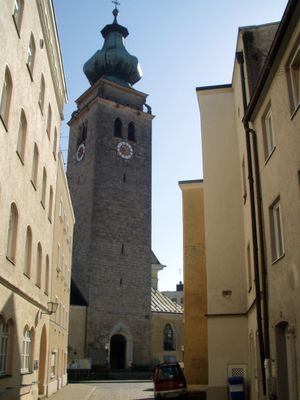
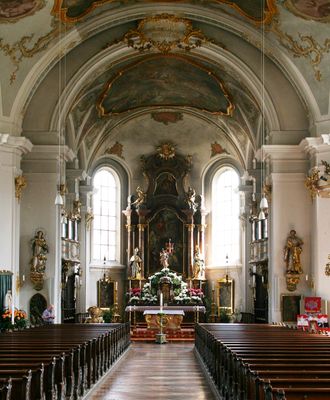
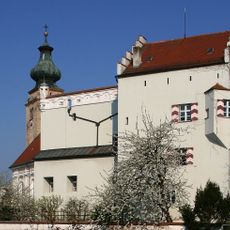
St. Nikolaus is a parish church in Mühldorf am Inn whose plain square tower of rough grey stone blocks rises between pale buildings, pierced by narrow openings and topped by a dark onion-shaped roof; round clock faces with Roman numerals sit on two of its sides above an arched entrance. The nave, rebuilt after 1768, has a detail-rich early Neoclassical façade with double pilasters and tall round-arched windows, contrasting with the bare Romanesque tower. Inside, a barrel-vaulted white nave carries a large gold-framed ceiling fresco and ornate stucco, with a carved high altar of gold columns and statues at the end.
St. Nikolaus was first built in 1251 but burned down and was rebuilt around 1300 as a Romanesque-early Gothic basilica. From 1432 to 1443 a late Gothic replacement kept the tower and the entrance portal. In 1768 the nave piers were narrowed during a Baroque remodelling and the nave collapsed; Salzburg court architect W. Hagenauer contributed to the design and Franz Alois Mayer of Trostberg led the rebuilding, completed in 1771 and consecrated in 1775. The tower received its set-back Baroque onion dome in 1764.
The parish church is dedicated to St. Nicholas, whose life is depicted in the nave frescoes painted by Martin Heigl in 1771/72; the choir shows him as an intercessor. The six bronze bells of the tower, both historic and newer, sound the sequence gis0 to gis1. The church became a parish church in 1803 after the Salzburg collegiate foundation, established in 1610, was dissolved.
The church is located near the center of Mühldorf am Inn and easy to reach on foot. Visitors should remember this is an active place of worship, so respectful behavior is appreciated when visiting.
The tower houses a six-bell bronze peal with the notes gis0, h0, cis1, e1, fis1 and gis1, mixing historic bells with newer ones. The organ, built by Max Sax in 1973, has 37 stops on three manuals and pedal and reuses some stops from the 1913 Siemann organ; its case dates from around 1770 and comes from Anton Bayr.
The community of curious travelers
AroundUs brings together thousands of curated places, local tips, and hidden gems, enriched daily by 94,459 contributors worldwide.