Drachentöterhaus, Architectural heritage monument in Mitte, Germany.
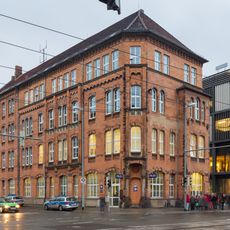
The Drachentöterhaus is a commercial building at Georgstraße 10, erected in 1900–1901 by architects Hermann Schaedtler and Karl Hantelmann. Its richly ornamented sandstone facade carries a nearly fully sculpted figure of Saint George as dragon-slayer, carved by Werner Hantelmann above the Georgspassage. The gabled complex forms a stylistic transition toward the former Haus Biermann, with a set-back decorative tower rising above the roofs.
The building was constructed around 1900 and initially served as a furniture showroom before transforming into a major commercial enterprise. The carved dragon-slayer figure by artist Werner Hantelmann was created during this period and has defined the building's appearance ever since.
The building's name comes from the near fully sculpted figure of Saint George as dragon-slayer carved by Werner Hantelmann above the Georgspassage. The same sculpture gave the house its other common name, Georgshaus, alongside Fugesches Haus after the furniture firm Louis Fuge that first occupied it.
The building sits at an easily recognizable corner intersection and is straightforward to locate. Inside, there are multiple levels with shops and ample space to navigate, making it easy for visitors to walk through and explore at their own pace.
The building's name changed with its uses: it was long called Fugesches Haus after the furniture store "Louis Fuge, Möbel, Decoration", and also Georgshaus after the saint. From 1966 Ernst Brinkmann expanded the sales floor to around 7,500 m² and marketed it as "Germany's largest technical department store" until the branch closed in 2001.
The community of curious travelers
AroundUs brings together thousands of curated places, local tips, and hidden gems, enriched daily by 95,167 contributors worldwide.