Erkelenz city walls, Medieval fortification in Erkelenz, Germany
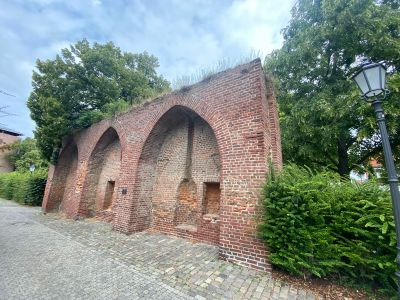
Erkelenz city walls are medieval fortifications that enclosed the city center in a pear-shaped configuration, featuring multiple gate towers and watchtowers along the perimeter. This defensive network created a controlled entry system for the settled area within.
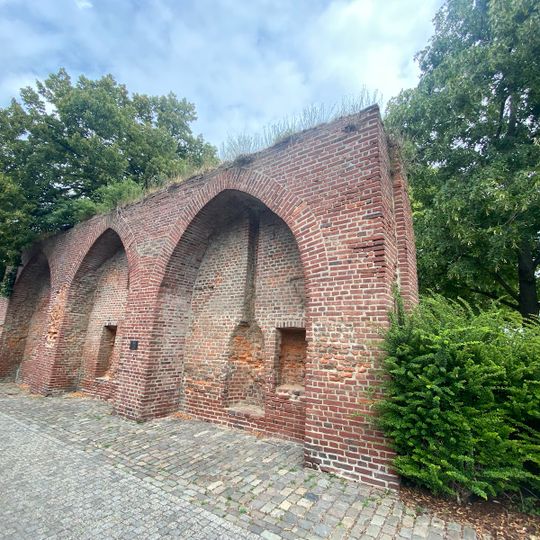
Construction of the walls began in the 11th century with an earthwork rampart and lasted about 160 years. The inner Brücktor was built in 1355 from stones of the destroyed Gripekoven castle, followed by the inner Maartor in 1416, the inner Oerather Tor in 1420, the outer Oerather Tor in 1454, the outer Maartor in 1459 and the outer Bellinghovener Tor in 1514. Most of the fortifications were demolished between 1816 and 1819, and surviving sections were restored in the mid-1950s.
The brick tower, nicknamed Hexenturm (Witches' Tower) before its 1950s restoration, was part of the castle that served as the seat of the bailiffs, a garrison and an armoury. Its lower cellar was used as a torture chamber, and the nearby Wolfsturm took its name from the howling of prisoners lowered through a hole in its ceiling.
The four promenade streets — Nordpromenade, Ostpromenade, Südpromenade and Westpromenade — follow the buried wall foundations and trace the pear-shaped outline of the old town. The restored section of the castle and wall stands at the Nordpromenade and along Wallstraße. The wall foundations lie beneath the promenade surfaces, so the circuit is best read from the street layout itself.
The Wolfsturm, a windowless rectangular stump inside the castle, served as the castle dungeon: prisoners were lowered through a round hole in the ceiling, and the tower got its name because their howls resembled wolves. The castle tower, now restored, was long called Hexenturm.
The community of curious travelers
AroundUs brings together thousands of curated places, local tips, and hidden gems, enriched daily by 93,936 contributors worldwide.