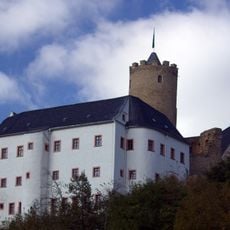
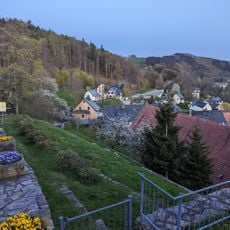
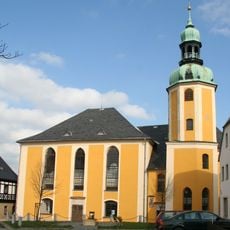
Drebacher Krokuswiesen, Natural monument in Drebach, Germany.
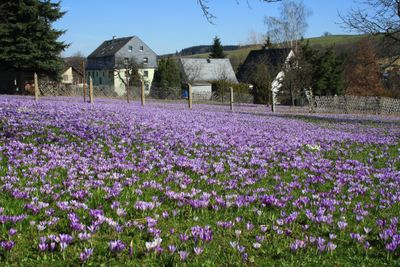
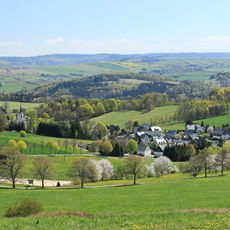
The Drebacher Krokuswiesen cover about 7 hectares in the lower part of Drebach in the Erzgebirge, made up of more than 40 individual areas registered as natural monuments. The flowers are spring crocuses of the species Crocus albiflorus subsp. neapolitanus, known locally as "Nackte Jungfern". They bloom from March to April.
According to legend, in the 17th century pastor David Rebentrost (1614–1703) treated Elector Johann Georg II of Saxony after a hunting accident at the Heinzebank. As thanks he was allowed to take three plants from the Dresden court garden: crocuses, the star-of-Bethlehem Ornithogalum umbellatum and a yew. The crocuses spread across lower Drebach; the meadows have been protected since 1934.
Locals call the spring crocuses "Nackte Jungfern" (naked maidens), a name still used in Drebach for the white and pale lilac flowers of Crocus albiflorus subsp. neapolitanus. The meadows are a Naturdenkmal made up of more than 40 separate parcels, and the March to April bloom is when residents and day-trippers walk the lower village to see them.
The best time to visit falls between March and April when the flowers are most abundant and visible. Sturdy footwear is recommended as the ground can become muddy depending on recent weather conditions.
The crocuses are Crocus albiflorus subsp. neapolitanus, called "Nackte Jungfern" (naked maidens) locally. The pastor also chose a yew and the umbellate star-of-Bethlehem; the yew survived in the parsonage garden until about 1980 and is still visible there as a dead trunk.
The community of curious travelers
AroundUs brings together thousands of curated places, local tips, and hidden gems, enriched daily by 93,970 contributors worldwide.