Echelsbacher Brücke, Arch road bridge in Rottenbuch, Germany
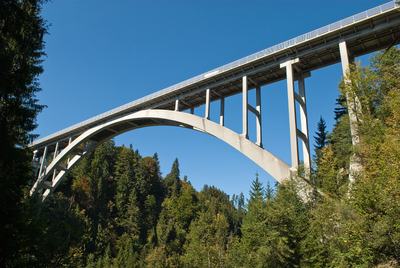
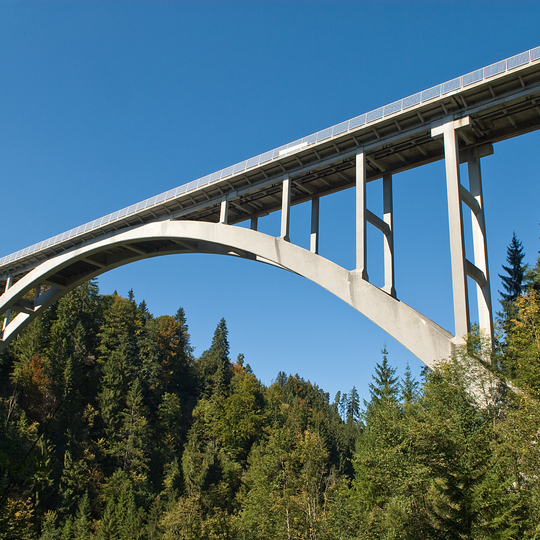
The Echelsbacher Brücke is a 183-metre-long Melan arch bridge over the Ammer between Rottenbuch and Bad Bayersoien. Its two hinged arch spans 130 metres with a rise of 31.8 metres, and the roadway runs 76 metres above the valley floor. The structure consists of two parallel arch ribs with rectangular hollow sections set 4.5 metres apart.
The bridge was completed in 1929 after 422 days of construction, at a cost of 900,000 Reichsmark, following a 1928 competition won by Hochtief with the engineers Streck and Zenns and the Eisenwerk Kaiserslautern. It used the Melan-Spangenberg method, in which a steel frame is encased in concrete. It was consecrated on 27 April 1930 by Cardinal Michael von Faulhaber.
The bridge crosses the Ammer at a point linked to the Roman road station "Coveliacas" of the Tabula Peutingeriana, about 30 km from Partenkirchen. From the 15th century, freight traffic on this route was organised as the "Rott", with goods stored in "Ballenhäusern" until enough carters gathered to continue under escort.
The bridge sees regular traffic and provides safe walking areas on the sides for pedestrians. Visiting during daylight hours allows you to see the structure clearly and view the Amper valley below.
The bridge's two steel arches were built simultaneously from the west and east sides, and when they met the two halves were only two centimetres apart. The 130-metre span made it the world's widest Melan arch bridge when it opened. Most of the 87,000 rivets were forged directly on the construction site.
The community of curious travelers
AroundUs brings together thousands of curated places, local tips, and hidden gems, enriched daily by 93,860 contributors worldwide.