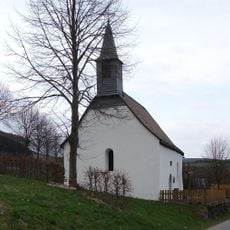
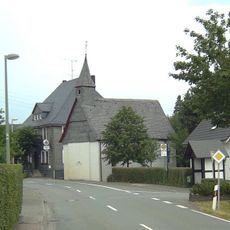
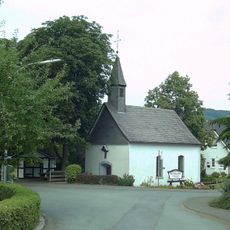
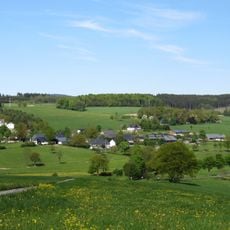
St. Cyriakus, Romanesque church in Berghausen, Germany
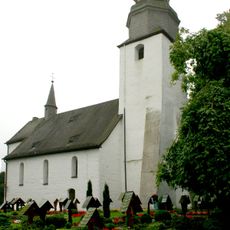
St. Cyriakus is a small three-aisled pillar basilica built around 1200–1220, with a Greek-cross plan of four equal arms. The nave has a single bay, the transept side apses, and the choir one bay with an apse; the side aisles extend to the middle of the west tower. Cross-ribbed vaults cover the nave, transept, choir and tower, while the aisles have barrel vaults.
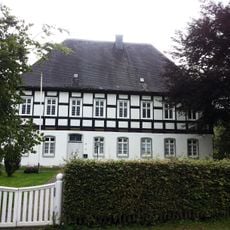
Built around 1200–1220 in Romanesque style, St. Cyriakus is among the oldest surviving churches in the Hochsauerlandkreis. The west portal dates from 1754, and the nearby vicarage was completed in 1715. A restoration from 1959 to 1962 removed Baroque altars, including the high altar, which was given to the Mariä-Himmelfahrt church in Schönholthausen. Further renovation began in early 2014 and was largely finished by Easter 2015.
The apse frescoes, painted around 1230, set Christ as Pantokrator in a mandorla, flanked by the four Evangelist symbols, Mary, John, Peter and Cyriacus. In the lowest row appear secular motifs: the Wheel of Fortune, probably the only surviving depiction of the pagan goddess Fortuna in an apse painting, with a king and an emperor losing his crown.
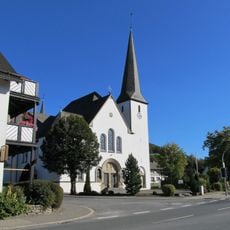
The church stands in the Berghausen district of Schmallenberg, consecrated to Saint Cyriacus. The round-arched south and west entrances lead into a compact three-aisled pillar basilica, so the painted apse is reached quickly. The west portal dates from 1754. A small opening in the choir wall, perhaps a hagioscope, now holds the eternal light.
In the lowest row of the apse frescoes, the Wheel of Fortune is shown with a king, probably Philip of Swabia, and an emperor, probably Otto of Brunswick, losing his crown. It is likely the only surviving depiction of the pagan goddess Fortuna in an apse painting.
The community of curious travelers
AroundUs brings together thousands of curated places, local tips, and hidden gems, enriched daily by 94,515 contributors worldwide.