Schlesischer Busch, Public park in Alt-Treptow, Berlin, Germany
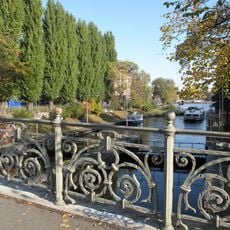
Schlesischer Busch is a public park of about 4.4 hectares along the Landwehr Canal in Alt-Treptow with paths through natural areas. A four-story concrete tower from East German times stands as a protected monument in the park and was restored in 2004.
Until the mid-19th century the area lay outside Berlin's city boundary and was part of the Cöllnische Heide, a coppiced woodland; from 1823 the magistrate had around 3,000 Morgen cleared by 1840, leaving only a few old oaks in the southeast of today's park. After the Wall was built, a border strip was laid out in June 1974 and the mesh fence replaced by a rear wall. The roughly ten-metre guard tower followed in the late 1970s; it has been a protected monument since 1992 and was restored and reopened on 9 November 2004, the 15th anniversary of the Wall's fall. The 4.4-hectare park itself was created in 1994.
The tower was occupied three days before border controls ended on 1 July 1990 by singer-songwriter Kalle Winkler, who turned it into a "Museum for Forbidden Art". From 1990 to 2000 the Museum der Verbotenen Kunst e. V. showed banned GDR artworks there, and since 2004 the Kunstfabrik am Flutgraben has run site-specific projects and a documentation on the border section.
The park is freely accessible with multiple entrances from nearby bus stops. Visitors should wear comfortable shoes since the paths go through natural terrain and can become muddy in rainy weather.
The tower's iron flaps on its loopholes were meant to give it a "defensive appearance"; other sources suggest the design was intended for securing the Soviet-Chinese border. The tower is one of only three surviving Berlin Wall watchtowers in the city.
The community of curious travelers
AroundUs brings together thousands of curated places, local tips, and hidden gems, enriched daily by 93,896 contributors worldwide.