Eimbecksches Haus, former city hall site in Hamburg, Germany
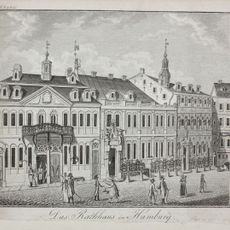
The Eimbecksches Haus was a stone building at the intersection of Kleine Johannisstrasse and Dornbusch in Hamburg's Old Town, functioning as the city's administrative center. Its basement housed extensive storage facilities for wine and beer, making the building economically important alongside its political purpose.
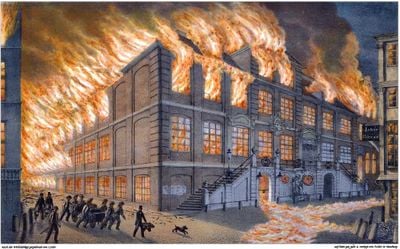
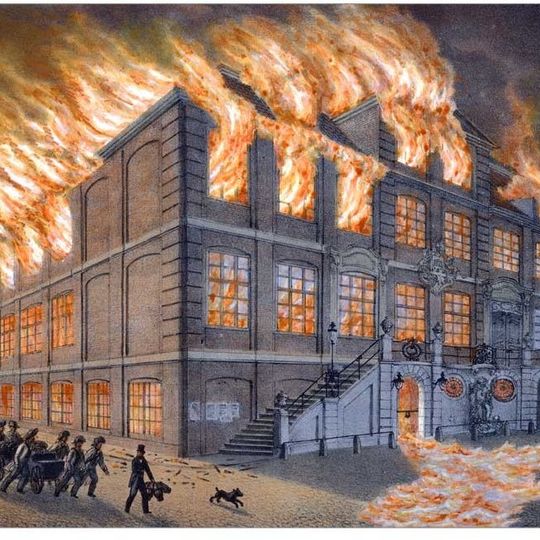
Built after the 1216 union of the episcopal Altstadt and the comital Neustadt, it served as Hamburg's third city hall, a 26-by-18-metre gabled house with a council hall reached by an arcade. A 1284 fire left only the vaulted cellar, which was used as the Ratsweinkeller from 1270 and as a wine house from 1293. A new building rose above it by the 14th century, was rebuilt in 1769–1771 under Johannes Kopp, and burned down on 6 May 1842.
The building became one of Hamburg's first places to serve coffee starting in 1668, introducing a new social drinking culture to the city. Visitors experienced a space that differed from the traditional wine rooms of the period.
The original location in the Old Town is no longer directly visitable, as the building was demolished in 1842. However, visitors can view the preserved Bacchus statue in the current city hall, which creates a connection to the site's history.
Before the ruins were cleared, a large Hamburg coat of arms above the double staircase and a Bacchus statue in a niche by the Ratsweinkeller entrance were removed. Both were carved in 1770 by the Swedish-born sculptor Johann Wilhelm Manstadt from Pirna sandstone. The Bacchus figure was later placed above the stairway down to the Ratsweinkeller in the present city hall, while the coat of arms went to the south gable of the Museum für Hamburgische Geschichte.
The community of curious travelers
AroundUs brings together thousands of curated places, local tips, and hidden gems, enriched daily by 93,541 contributors worldwide.