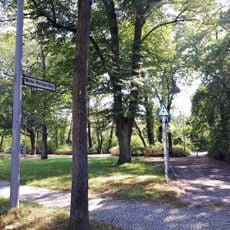
Zehlendorf Forest Cemetery, cemetery in Berlin, Germany
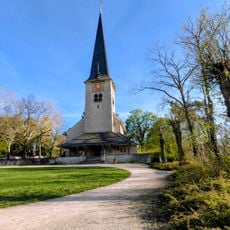
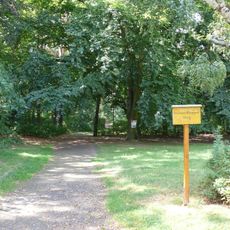
Zehlendorf Forest Cemetery is a burial ground in southwestern Berlin surrounded by fir, oak, and birch trees, with straight and curved paths guiding visitors through different sections. The site consists of meadow and forest areas, with roughly one-third remaining as natural woodland.
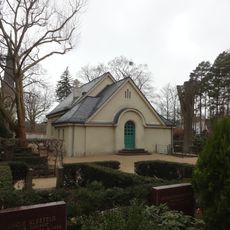
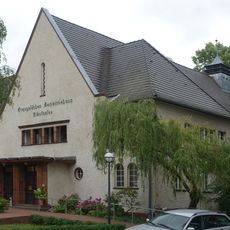
The northern section was planned in 1945, right after World War II, and laid out between 1946 and 1947 by Herta Hammerbacher; Max Dietrich expanded it from 1948 to 1954. An Italian war cemetery followed in 1953, holding 1,170 grave plates of prisoners of war and military internees, among them 127 victims of the Treuenbrietzen massacre. The funeral halls on the natural hill were built only in 1956–1958 to plans by Sergius Ruegenberg and Wolf von Möllendorff.
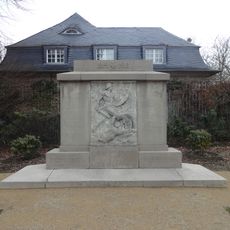
The cemetery is named after the former Zehlendorf district, not after its trees. Since 2002, 43 graves have been designated Ehrengräber, maintained by the Berlin Senate; among them are Willy Brandt, Ernst Reuter and Otto Suhr. The Italian war cemetery of 1953 holds 1,170 grave plates, including 127 victims of the Treuenbrietzen massacre.
The cemetery has two entrances, one from 1950 on Potsdamer Chaussee and another from 1959 on Wasgensteig, allowing ample time to explore and walk through different sections. There are no shops or large facilities inside, so visitors should come prepared for their own needs.
Willy Brandt's grave, marked by a rough-hewn light grey stone engraved with his name, lies under hedges with lilies and trailing yellow flowers in front. The cemetery holds 43 graves of honour (as of 2002) maintained by the Berlin Senate, including those of Ernst Reuter, Otto Suhr and Klaus Schütz.
The community of curious travelers
AroundUs brings together thousands of curated places, local tips, and hidden gems, enriched daily by 94,638 contributors worldwide.