Schwedt Palace, Baroque castle in Schwedt/Oder, Germany
Schwedt Palace was a three-winged Baroque residence modelled on Dutch examples, with two towers framing the garden facade and a gabled central risalit. A chestnut avenue 100 metres wide led to the cour d'honneur on the town side. The north wing was added by Martin Heinrich Böhme in 1701–1704, after Cornelis Ryckwaert's rebuild of the old Renaissance palace lasted until 1685.
Electress Dorothea, second wife of the Great Elector Frederick William, bought Schwedt back from its lease in 1670 to give her eldest son Philipp Wilhelm, who had no claim to the throne, a residence. The Dutch architect Cornelis Ryckwaert rebuilt the ruined Renaissance palace of 1553–1569, keeping surviving parts, until 1685; Martin Heinrich Böhme added the north wing in 1701–1704. The Hohenzollerns held it until 1945.
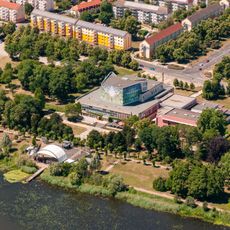
The palace gave its name to the Brandenburg-Schwedt branch of the Hohenzollerns, the cadet line it housed from 1689. Its site is now occupied by the Kulturhaus that holds the Uckermärkische Bühnen Schwedt, and the former palace garden became the Europäischer Hugenottenpark between 2009 and 2012, where copies of seven sandstone sculptures by Friedrich Christian Glume and a sundial of 1740 stand among old trees.
The palace no longer stands: the ruins were blown up in 1962 and the last remains cleared by 1969. On the site now is the Kulturhaus housing the Uckermärkischen Bühnen Schwedt theatre. The former palace garden, laid out from 2009 to 2012 as the Europäischer Hugenottenpark, is freely walkable and holds old trees, copies of seven Baroque sandstone sculptures and a sundial of 1740.
A scale model of the palace was funded by donations from local residents and stands at the historic site today. Alongside the model are seven replicated Baroque sandstone sculptures and an original sundial dating to 1740.
The community of curious travelers
AroundUs brings together thousands of curated places, local tips, and hidden gems, enriched daily by 92,926 contributors worldwide.